
Card #098 · Invertebrates
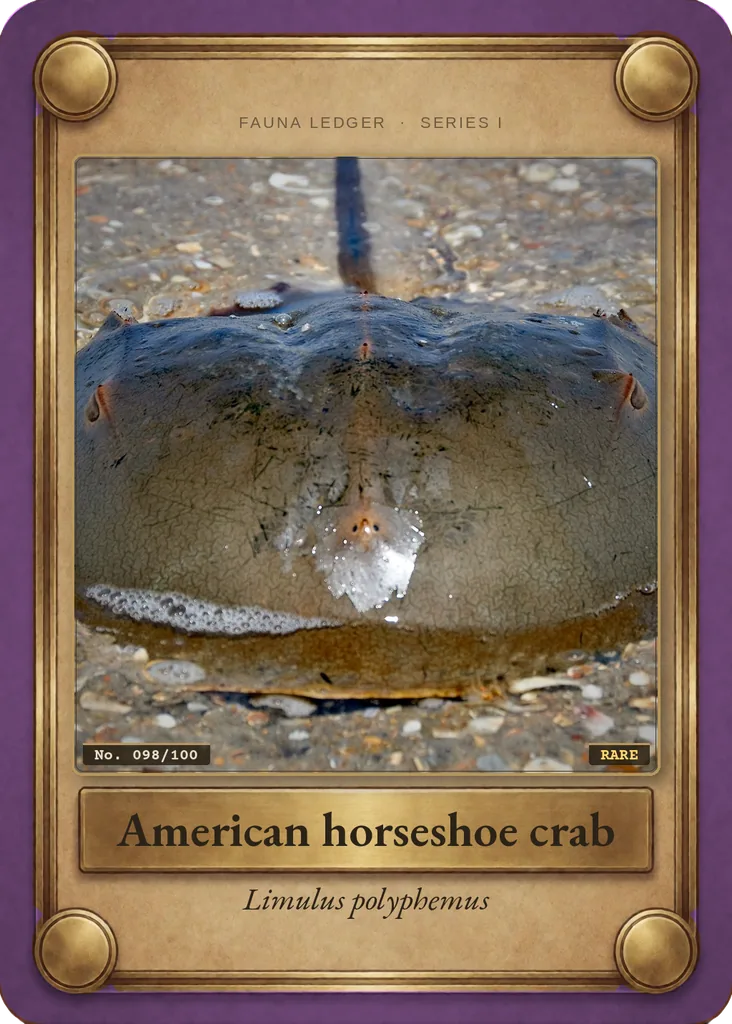
American horseshoe crab
Limulus polyphemus
Rare VU · Vulnerable
Field notes
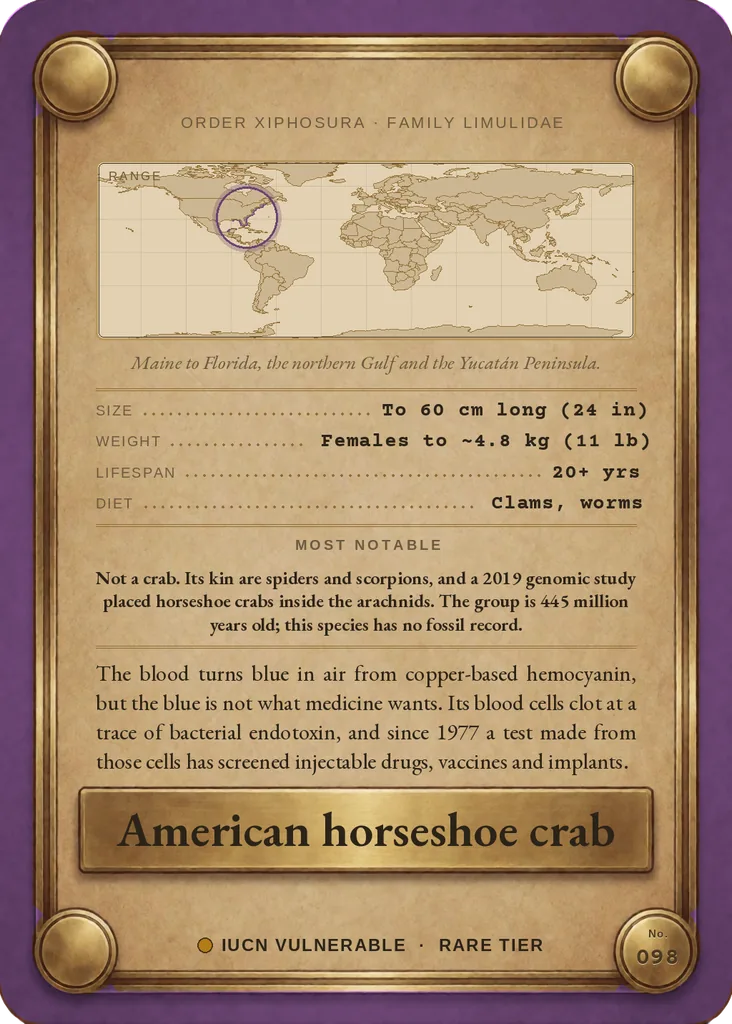
- Classification
- Order Xiphosura · Family Limulidae
- Range
- Atlantic coast of North America, Maine to Florida, the northeast Gulf of Mexico and the Yucatán Peninsula
- Size
- To 60 cm long (24 in)
- Weight
- Females to ~4.8 kg (11 lb)
- Lifespan
- 20+ yrs
- Diet
- Clams, worms
Most Notable
Not a crab. Its kin are spiders and scorpions, and a 2019 genomic study placed horseshoe crabs inside the arachnids. The group is 445 million years old; this species has no fossil record.
The blood turns blue in air from copper-based hemocyanin, but the blue is not what medicine wants. Its blood cells clot at a trace of bacterial endotoxin, and since 1977 a test made from those cells has screened injectable drugs, vaccines and implants.
Endotoxin comes from the cell walls of certain bacteria and can cause fever or shock if injected, even when the bacteria are dead. Hundreds of thousands of horseshoe crabs are caught each year, partly bled and released, and regulators estimate about 15% die from it.
There is now an alternative. Recombinant Factor C copies the first enzyme of the crab's clotting reaction from its gene, with no crab needed. Europe accepted it in 2021 and the US Pharmacopeia made it an official method in May 2025, though the crab-based test is still allowed.
The 445-million-year figure belongs to horseshoe crabs as a group, from a fossil found in Manitoba. The lineage has kept changing, and the oldest fossils of the genus Limulus are from the Late Cretaceous, so 'living fossil' oversells it.
Vulnerable is the global status, set in 2016, and the risk is uneven: highest in the Gulf of Maine and the Yucatán, where Mexico lists it as endangered. Its eggs in Delaware Bay fuel migrating red knots, a shorebird listed as threatened in the US.
The two bumps on the sides of the shell are compound eyes. Research on them was part of the work that won H. Keffer Hartline the 1967 Nobel Prize in medicine.
Range: Maine to Florida, the northern Gulf and the Yucatán Peninsula.