
Card #093 · Invertebrates
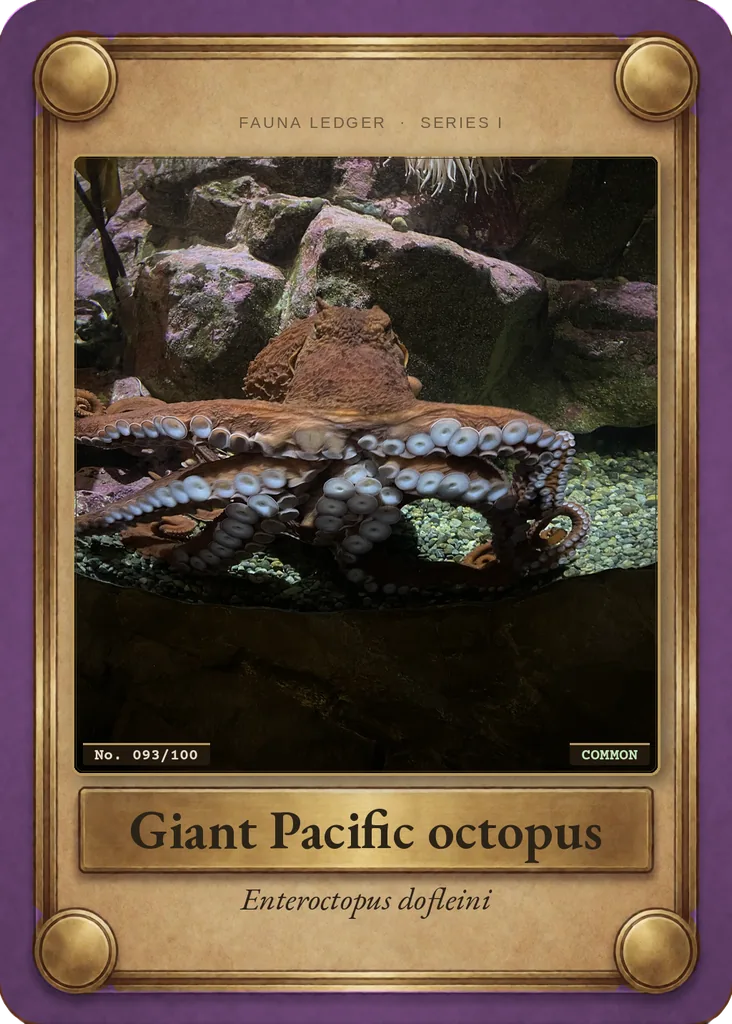
Giant Pacific octopus
Enteroctopus dofleini
Common LC · Least Concern
Field notes
- Classification
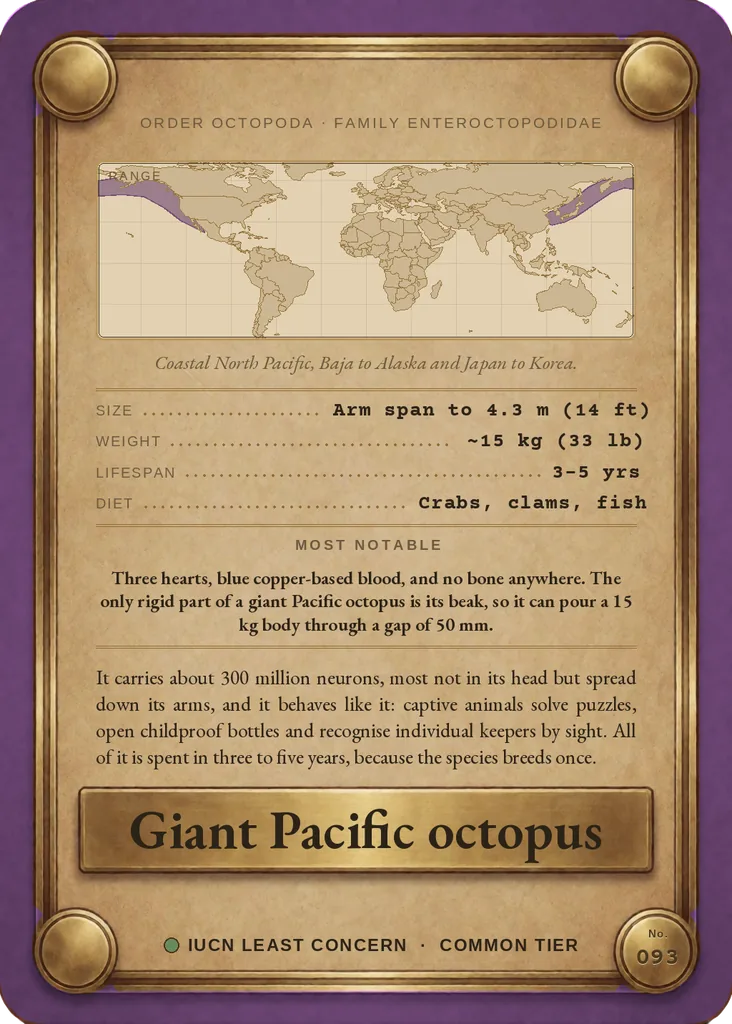
- Order Octopoda · Family Enteroctopodidae
- Range
- North Pacific coast
- Size
- Arm span to 4.3 m (14 ft)
- Weight
- ~15 kg (33 lb)
- Lifespan
- 3–5 yrs
- Diet
- Crabs, clams, fish
Most Notable
Three hearts, blue copper-based blood, and no bone anywhere. The only rigid part of a giant Pacific octopus is its beak, so it can pour a 15 kg body through a gap of 50 mm.
It carries about 300 million neurons, most not in its head but spread down its arms, and it behaves like it: captive animals solve puzzles, open childproof bottles and recognise individual keepers by sight. All of it is spent in three to five years, because the species breeds once.
A female lays between 120,000 and 400,000 eggs, guards them without feeding until they hatch, and dies; the male dies within months of mating too.
The largest suckers are about 6.4 cm across and each can hold roughly 16 kg, and the animal has been recorded taking spiny dogfish sharks up to 1.2 m long.
Its blood is copper-based rather than iron-based, which carries oxygen well in cold water but makes it acutely sensitive to falling ocean pH.
Range: Coastal North Pacific, Baja to Alaska and Japan to Korea.