
Card #092 · Amphibians
Axolotl
Ambystoma mexicanum
Ultra Rare CR · Critically Endangered
Field notes
- Classification
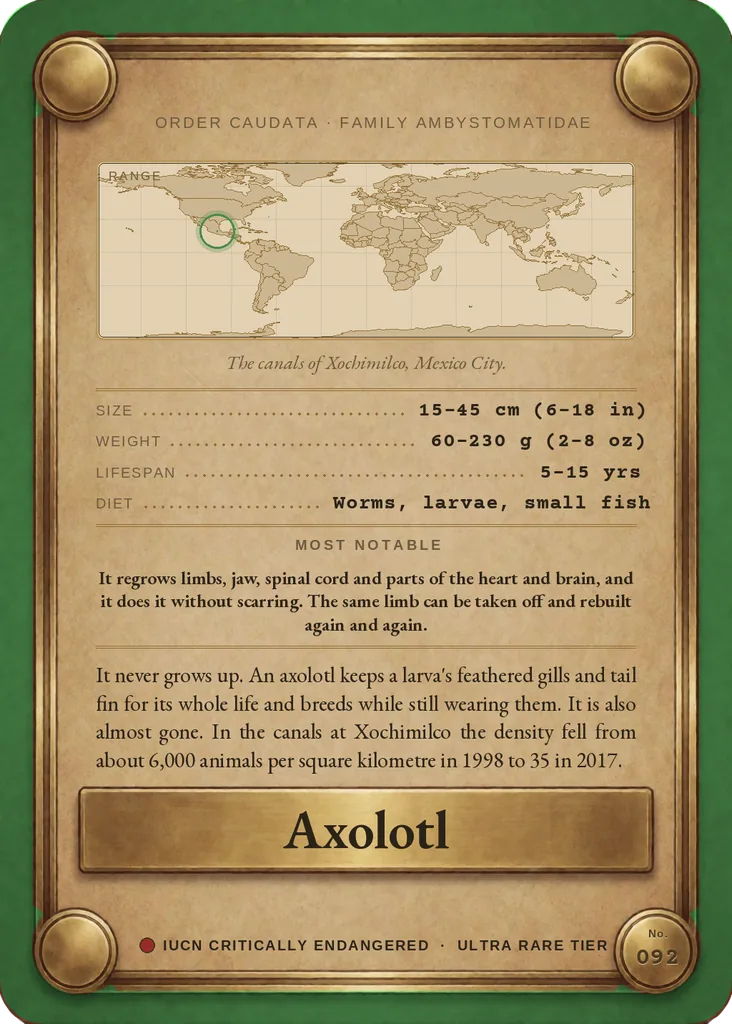
- Order Caudata · Family Ambystomatidae
- Range
- Lake Xochimilco, Mexico City
- Size
- 15–45 cm (6–18 in)
- Weight
- 60–230 g (2–8 oz)
- Lifespan
- 5–15 yrs
- Diet
- Worms, larvae, small fish
Most Notable
It regrows limbs, jaw, spinal cord and parts of the heart and brain, and it does it without scarring. The same limb can be taken off and rebuilt again and again.
It never grows up. An axolotl keeps a larva's feathered gills and tail fin for its whole life and breeds while still wearing them. It is also almost gone. In the canals at Xochimilco the density fell from about 6,000 animals per square kilometre in 1998 to 35 in 2017.
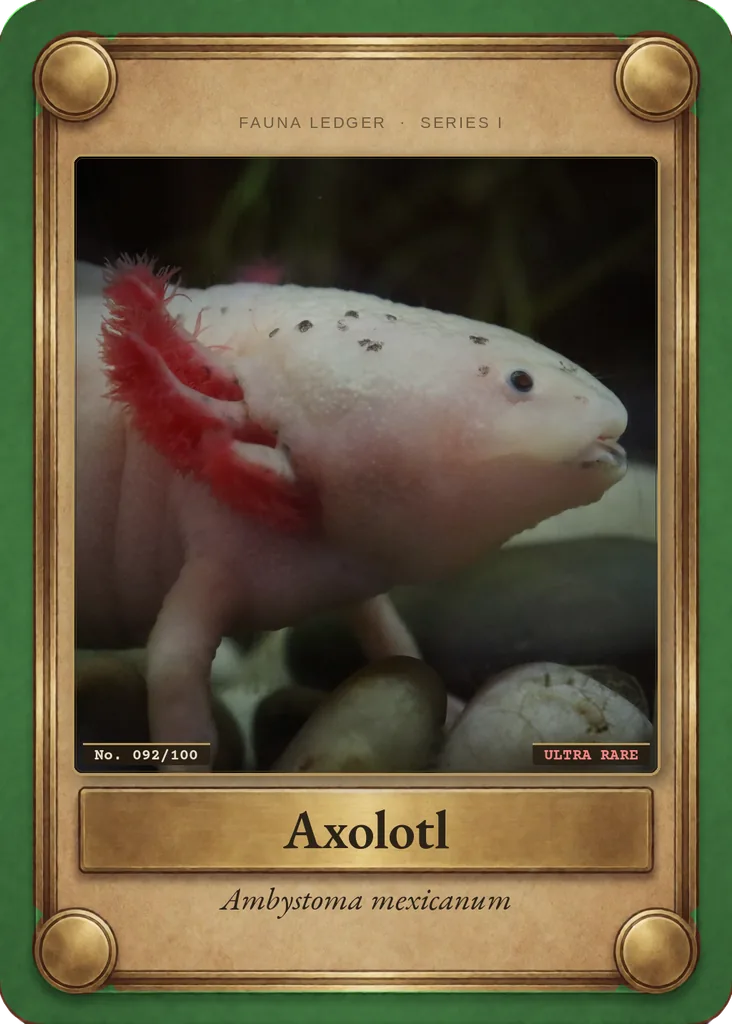
The pale pink animal in this photograph is leucistic, a captive colour form. Wild axolotls are dark olive-brown and heavily mottled, which is worth saying plainly, because the pink one is the only axolotl most people have ever seen.
There may be somewhere between 50 and 1,000 left in the wild, in one canal system on the southern edge of Mexico City. Lake Chalco, the other half of its historic range, was drained long ago.
At the same time it is one of the most abundant laboratory animals on earth. Tens of thousands live in tanks in labs and homes worldwide. A species can be everywhere in captivity and still be at the end of the line in the only place it comes from.
It can be made to grow up. Given thyroid hormone, an axolotl will metamorphose into a land-going salamander with lungs and no gills, an adult form it never reaches by itself in the wild.
Range: The canals of Xochimilco, Mexico City.