
Card #088 · Amphibians
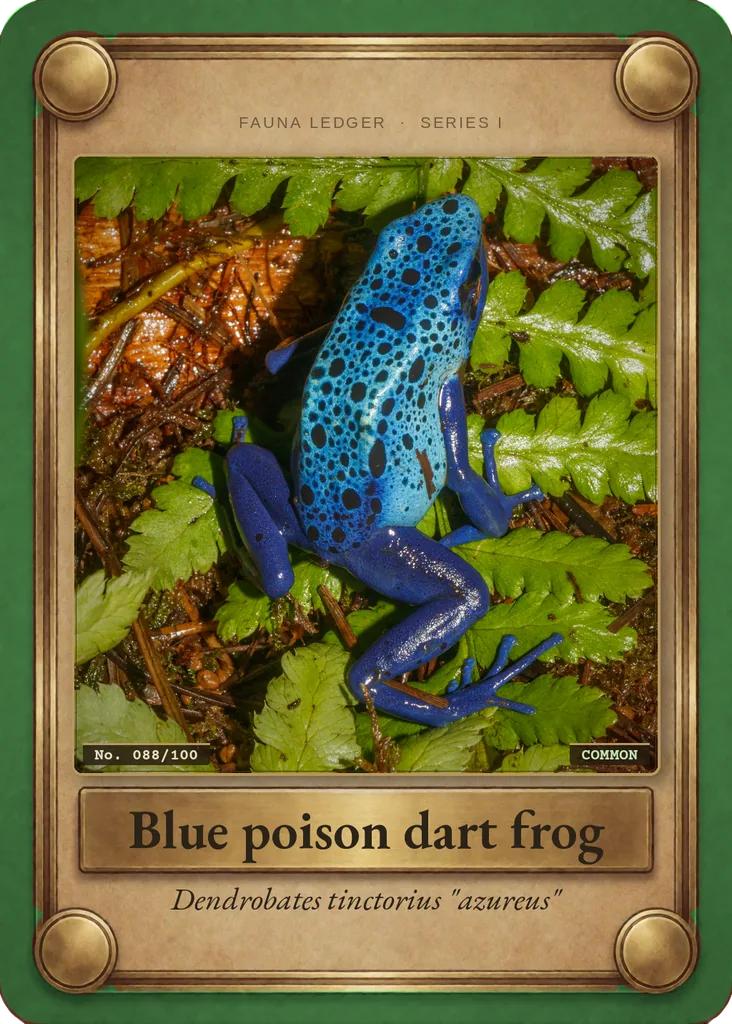
Blue poison dart frog
Dendrobates tinctorius "azureus"
Common LC · Least Concern
Field notes
- Classification
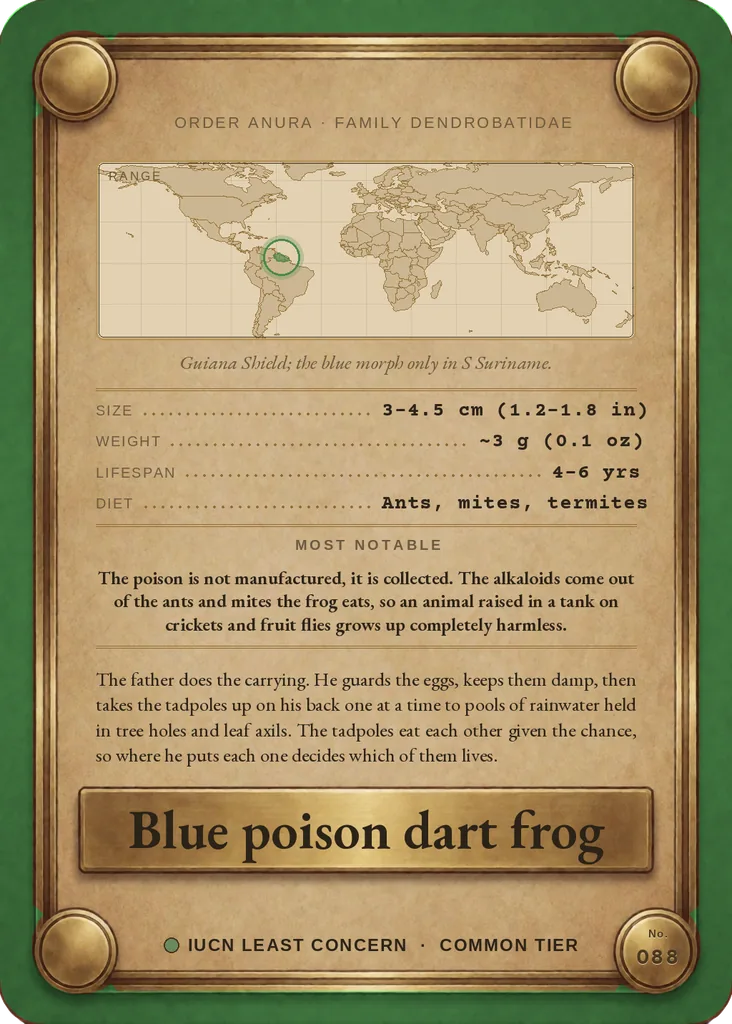
- Order Anura · Family Dendrobatidae
- Range
- Southern Suriname
- Size
- 3–4.5 cm (1.2–1.8 in)
- Weight
- ~3 g (0.1 oz)
- Lifespan
- 4–6 yrs
- Diet
- Ants, mites, termites
Most Notable
The poison is not manufactured, it is collected. The alkaloids come out of the ants and mites the frog eats, so an animal raised in a tank on crickets and fruit flies grows up completely harmless.
The father does the carrying. He guards the eggs, keeps them damp, then takes the tadpoles up on his back one at a time to pools of rainwater held in tree holes and leaf axils. The tadpoles eat each other given the chance, so where he puts each one decides which of them lives.
The blue frog in this photograph is a colour morph, not a species. It was described as Dendrobates azureus in 1969 and is now treated as Dendrobates tinctorius, which comes in yellow, white and black patterns elsewhere in the Guianas.
The blue form lives in one place on earth: forest islands standing in the Sipaliwini savanna of southern Suriname, at around 315 to 430 m.
A wild adult carries roughly 200 micrograms of alkaloid and about 2 micrograms would be a lethal dose for a person. The warning colour is honest advertising.
Females sometimes return to the pools to drop unfertilised eggs for the tadpoles to eat, though unlike the Oophaga frogs they do not depend on it.
Range: Guiana Shield; the blue morph only in S Suriname.