
Card #083 · Amphibians
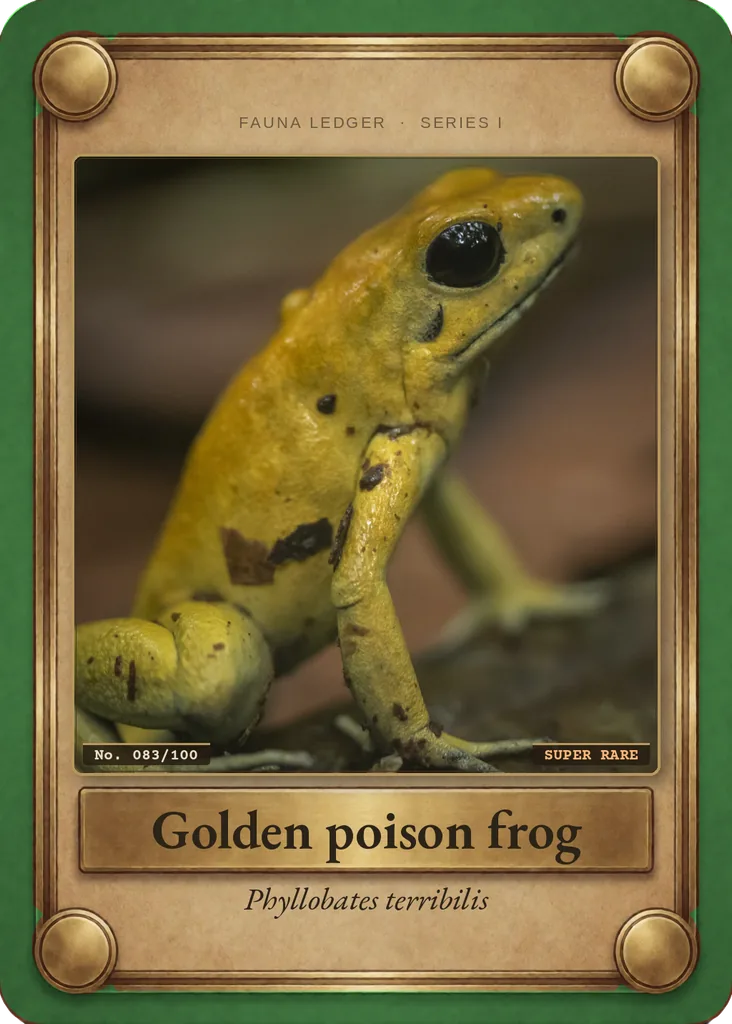
Golden poison frog
Phyllobates terribilis
Super Rare EN · Endangered
Field notes
- Classification
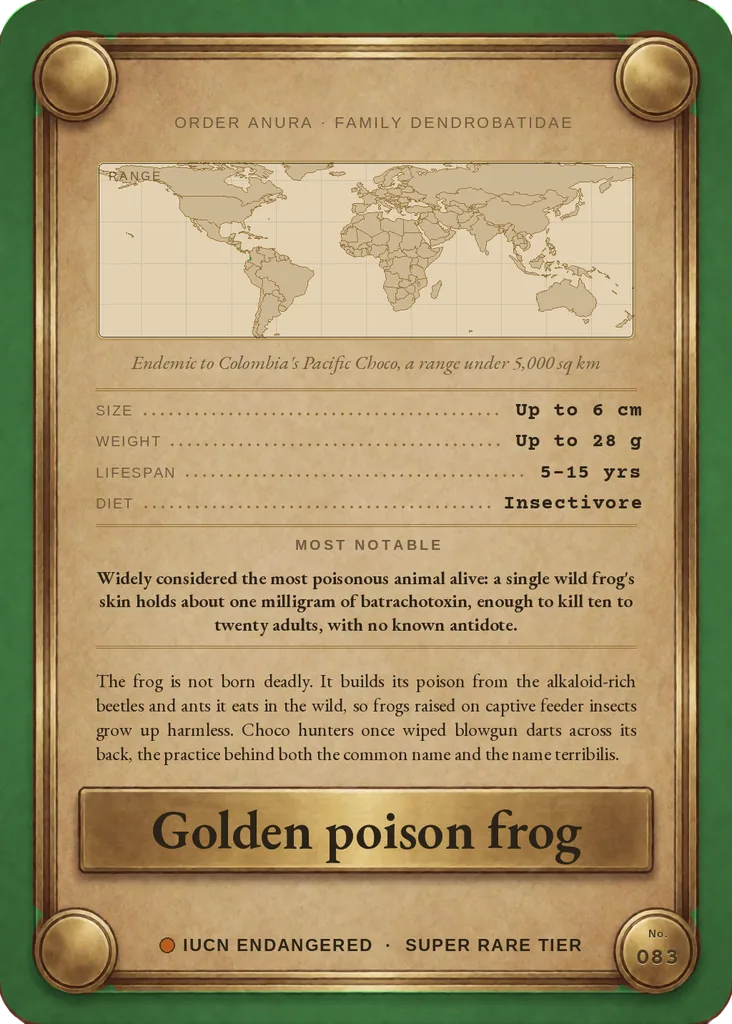
- Order Anura · Family Dendrobatidae
- Range
- Pacific coast of Colombia
- Size
- Up to 6 cm
- Weight
- Up to 28 g
- Lifespan
- 5–15 yrs
- Diet
- Insectivore
Most Notable
Widely considered the most poisonous animal alive: a single wild frog's skin holds about one milligram of batrachotoxin, enough to kill ten to twenty adults, with no known antidote.
The frog is not born deadly. It builds its poison from the alkaloid-rich beetles and ants it eats in the wild, so frogs raised on captive feeder insects grow up harmless. Choco hunters once wiped blowgun darts across its back, the practice behind both the common name and the name terribilis.
To avoid poisoning itself, the golden poison frog carries a tiny mutation in its own sodium channels that makes its nerves and muscles immune to the batrachotoxin coating its skin.
Its entire world is a sliver of humid rainforest on Colombia's Pacific coast, under 5,000 square kilometers and shrinking to logging, agriculture, and pollution, which is why the IUCN lists it as Endangered with a decreasing population.
It is the largest of the poison dart frogs at up to 6 cm, and its brilliant color is aposematic, a billboard that advertises the danger rather than hiding from it. Wild frogs also occur in mint-green and orange forms.
Captive-bred golden poison frogs are common in the pet trade and are considered non-toxic, but wild-caught animals can stay dangerous for years even on a captive diet.
Range: Endemic to Colombia's Pacific Choco, a range under 5,000 sq km