
Card #081 · Fish
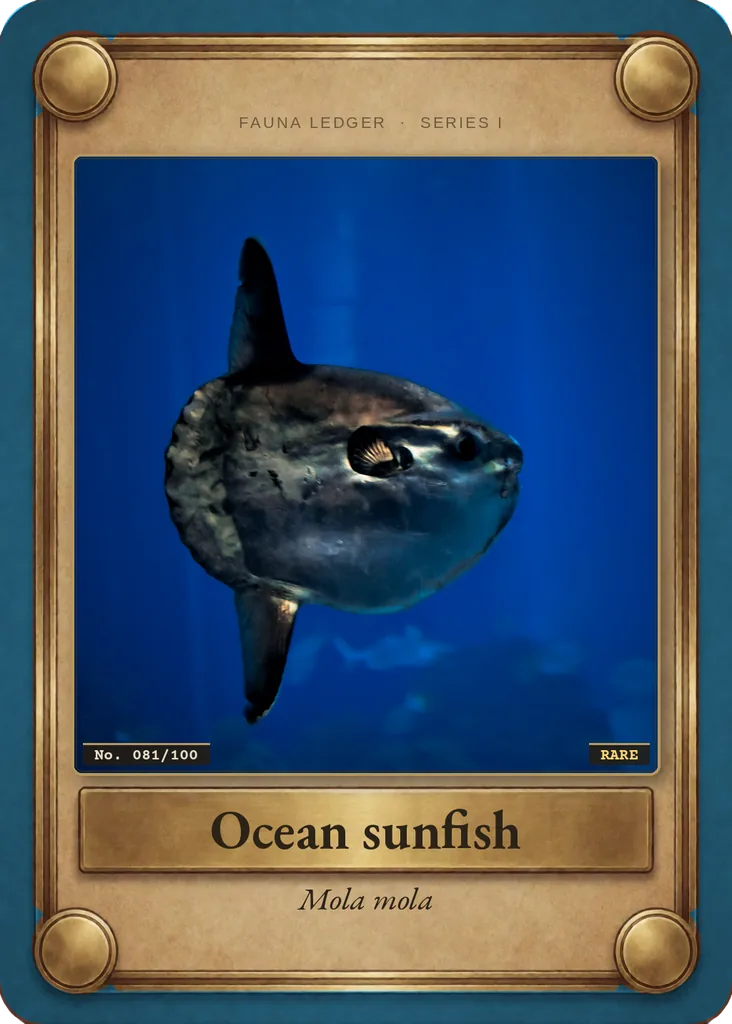
Ocean sunfish
Mola mola
Rare VU · Vulnerable
Field notes
- Classification
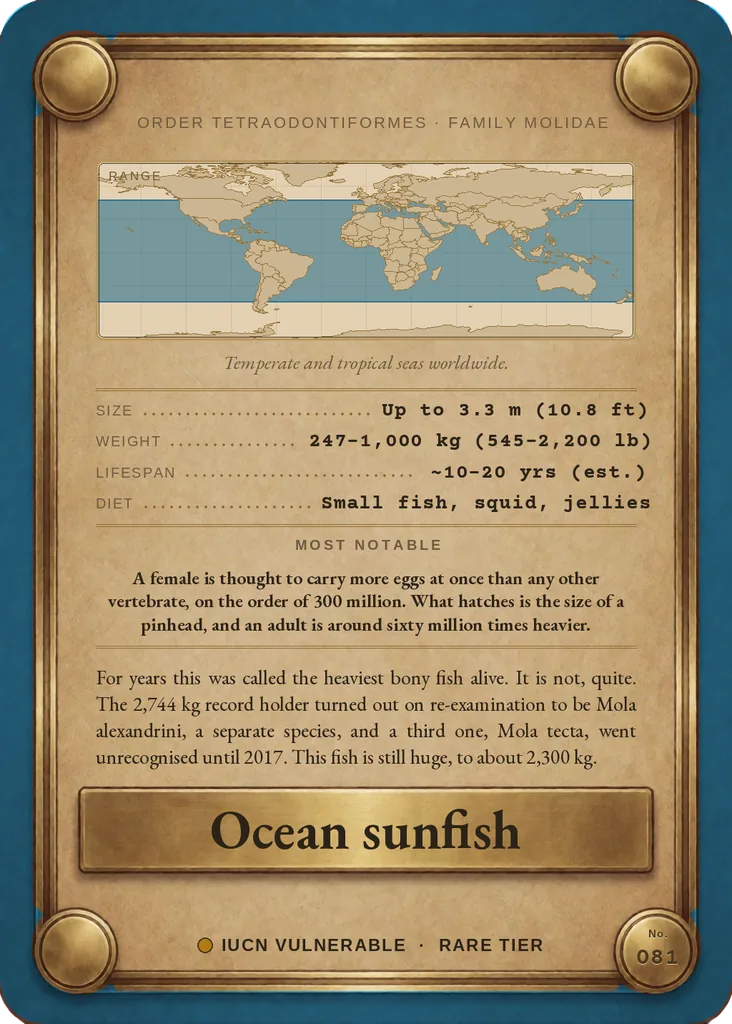
- Order Tetraodontiformes · Family Molidae
- Range
- Temperate and tropical seas worldwide
- Size
- Up to 3.3 m (10.8 ft)
- Weight
- 247–1,000 kg (545–2,200 lb)
- Lifespan
- ~10–20 yrs (est.)
- Diet
- Small fish, squid, jellies
Most Notable
A female is thought to carry more eggs at once than any other vertebrate, on the order of 300 million. What hatches is the size of a pinhead, and an adult is around sixty million times heavier.
For years this was called the heaviest bony fish alive. It is not, quite. The 2,744 kg record holder turned out on re-examination to be Mola alexandrini, a separate species, and a third one, Mola tecta, went unrecognised until 2017. This fish is still huge, to about 2,300 kg.
It looks like a fish that stops halfway. There is no real tail: the body ends in a stiff rudder called a clavus, and the animal swims by sculling with the tall dorsal and anal fins, which is why it is sometimes mistaken for a shark at the surface.
It is not the jellyfish specialist it is usually described as. Diet studies find a generalist predator eating small fish, larvae, squid and crustaceans, with gelatinous prey only a modest part of it.
The basking is thermal. A sunfish dives into cold deep water to feed, then comes up and lies on its side at the surface to warm back up, which is also when gulls land on it and pick the parasites off.
More than forty species of parasite live on and in one. Sunfish visit cleaning stations on reefs and hold still while wrasse work them over, and they have been recorded breaching clear of the water, possibly for the same reason.
Range: Temperate and tropical seas worldwide.