
Card #077 · Fish
Pacific bluefin tuna
Thunnus orientalis
Uncommon NT · Near Threatened
Field notes
- Classification
- Order Scombriformes · Family Scombridae
- Range
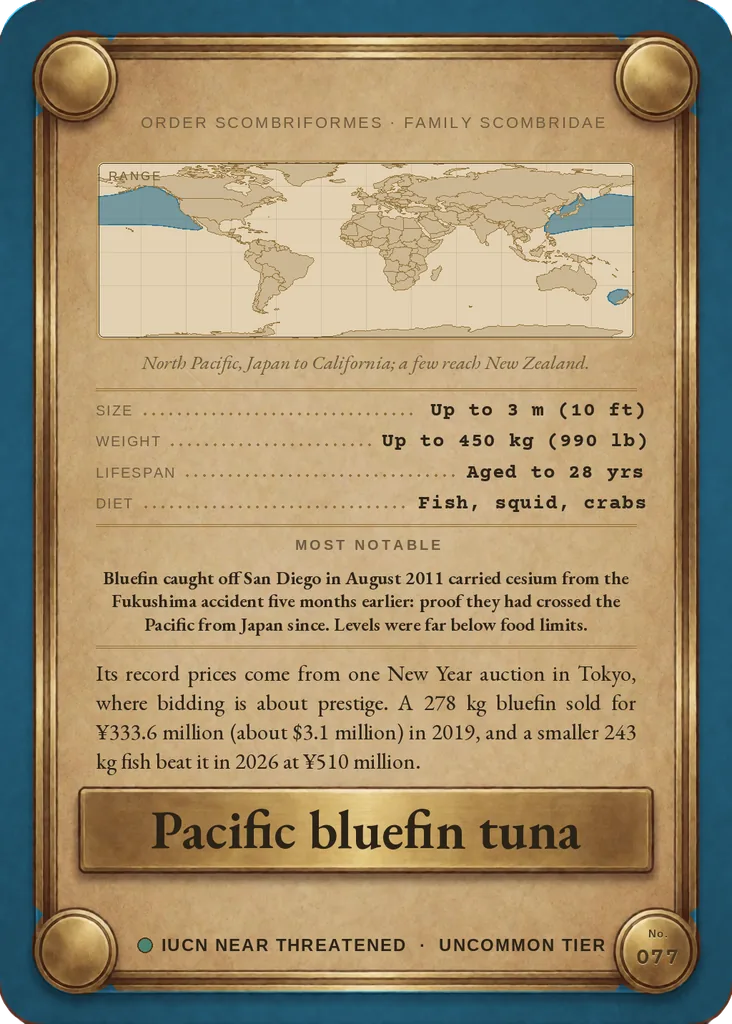
- North Pacific Ocean; spawns only in the western Pacific, off Japan and Taiwan
- Size
- Up to 3 m (10 ft)
- Weight
- Up to 450 kg (990 lb)
- Lifespan
- Aged to 28 yrs
- Diet
- Fish, squid, crabs
Most Notable
Bluefin caught off San Diego in August 2011 carried cesium from the Fukushima accident five months earlier: proof they had crossed the Pacific from Japan since. Levels were far below food limits.
Its record prices come from one New Year auction in Tokyo, where bidding is about prestige. A 278 kg bluefin sold for ¥333.6 million (about $3.1 million) in 2019, and a smaller 243 kg fish beat it in 2026 at ¥510 million.
Near Threatened is the Red List status from the 2021 assessment, which moved the species from Vulnerable (listed 2014) because newer stock assessments were available. That assessment still called it severely depleted, at under 5% of its original biomass.
The recovery since is real. The 2024 international stock assessment puts the spawning stock at 2% of its unfished size in 2010 and 23% in 2022, more than ten times higher, after catch limits on young fish. Both rebuilding targets were met years ahead of schedule.
Every Pacific bluefin is born in the western Pacific, between the Ryukyu Islands and Taiwan or in the Sea of Japan. Some young fish cross the ocean to California and Mexico, spend several years there, then swim back west to spawn.
The Fukushima cesium in those fish was a tracer, not a hazard. A 2013 follow-up study found the extra dose from eating them was thousands of times smaller than the dose from natural polonium already in the same fish.
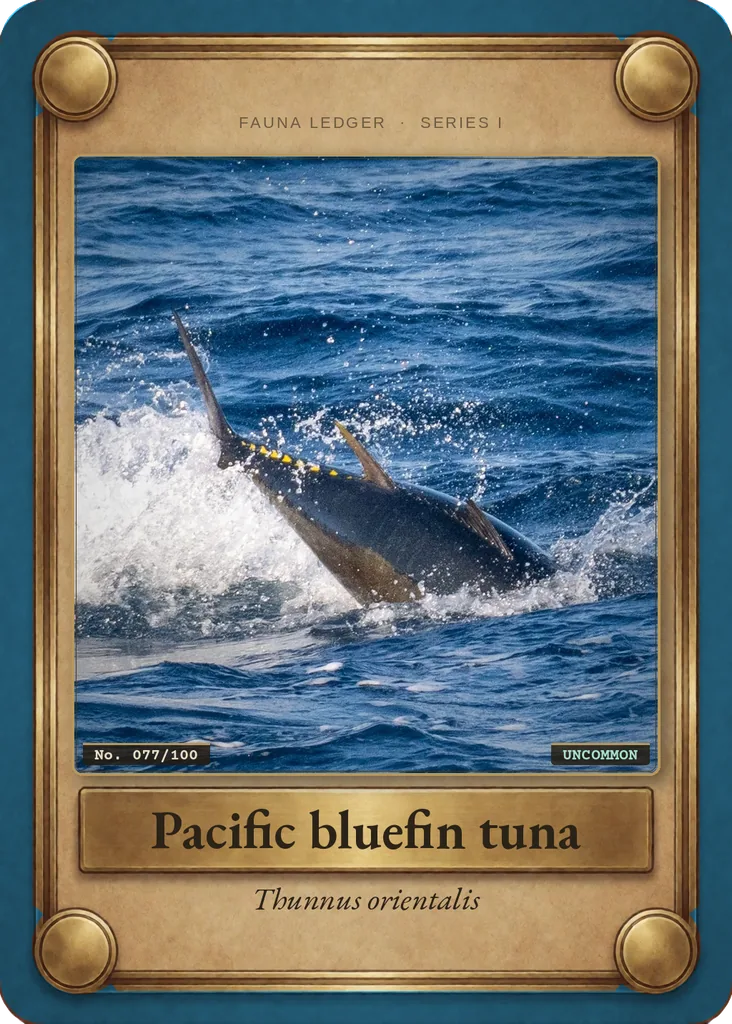
The photo shows a wild bluefin diving at the surface in the open northwest Pacific, east of Hokkaido, in September 2026.
Range: North Pacific, Japan to California; a few reach New Zealand.