
Card #076 · Fish
Red-bellied piranha
Pygocentrus nattereri
Common LC · Least Concern

Field notes
- Classification
- Order Characiformes · Family Serrasalmidae
- Range
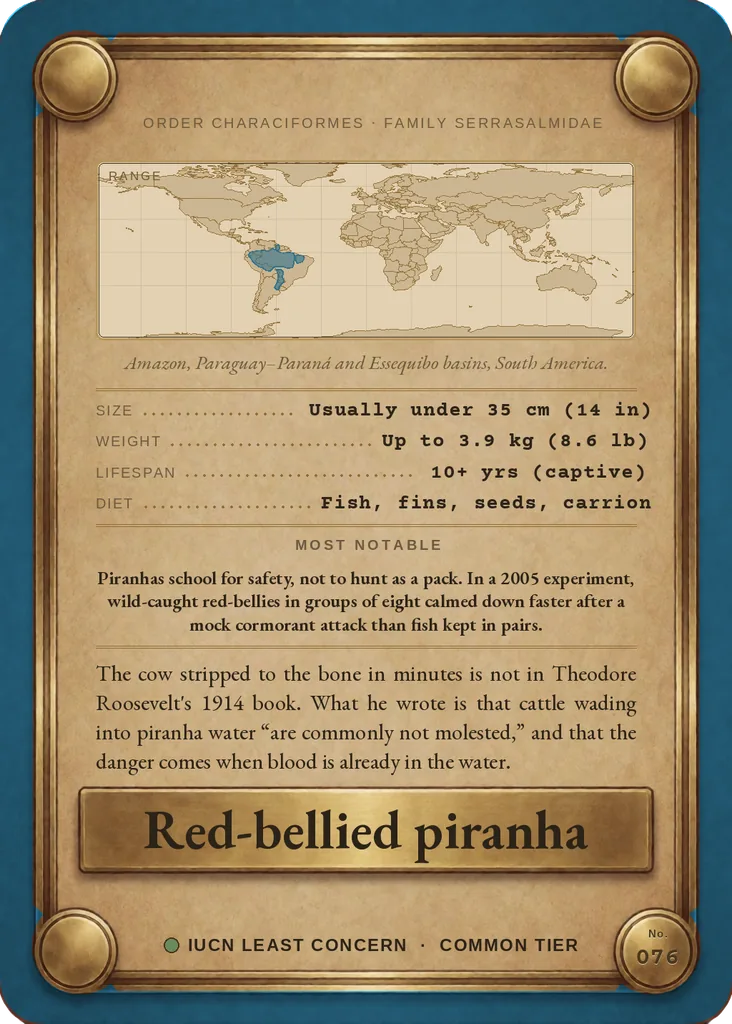
- Amazon, Paraguay–Paraná and Essequibo basins, and rivers of northeastern Brazil
- Size
- Usually under 35 cm (14 in)
- Weight
- Up to 3.9 kg (8.6 lb)
- Lifespan
- 10+ yrs (captive)
- Diet
- Fish, fins, seeds, carrion
Most Notable
Piranhas school for safety, not to hunt as a pack. In a 2005 experiment, wild-caught red-bellies in groups of eight calmed down faster after a mock cormorant attack than fish kept in pairs.
The cow stripped to the bone in minutes is not in Theodore Roosevelt's 1914 book. What he wrote is that cattle wading into piranha water "are commonly not molested," and that the danger comes when blood is already in the water.
Piranhas bark. A 2011 study linked three sounds to three behaviours: a bark when a fish squares up face to face with a rival, a single low thump while two circle and fight, and a rapid clicking made with the jaws during a chase. The first two come from muscles drumming on the swim bladder. Even Roosevelt noticed that landed piranhas made "an extraordinary squealing sound."
It is not mainly a scavenger either. In a 2014 study of 442 fish from the Pantanal, other fish were the main food in both the wet and dry seasons, with seeds and plant matter second. It is an opportunist that hunts, nips fins and scales, and takes carrion when it finds it.
It replaces its teeth in batches, one side of the jaw at a time, so it always has a working bite. In 1915 a piranha genus was even named Rooseveltiella; it has since been folded back into Pygocentrus.
About the photo: this is a living red-bellied piranha at the Georgia Aquarium. Nearly every wild photo of this fish shows it on a hook or in an angler's hand, so we chose a live fish in a tank instead. Wild fish look much the same.
The map shows the native range. People have also released piranhas into lakes and rivers outside it, in Brazil and beyond, and those are not drawn.
Range: Amazon, Paraguay–Paraná and Essequibo basins, South America.