
Card #070 · Reptiles
Gharial
Gavialis gangeticus
Ultra Rare CR · Critically Endangered
Field notes
- Classification
- Order Crocodylia · Family Gavialidae
- Range
- A few rivers of northern India and southern Nepal
- Size
- Males to 6 m (20 ft)
- Weight
- ~160–180 kg (350–400 lb)
- Lifespan
- 59 yrs max (captive)
- Diet
- Almost entirely fish
Most Notable
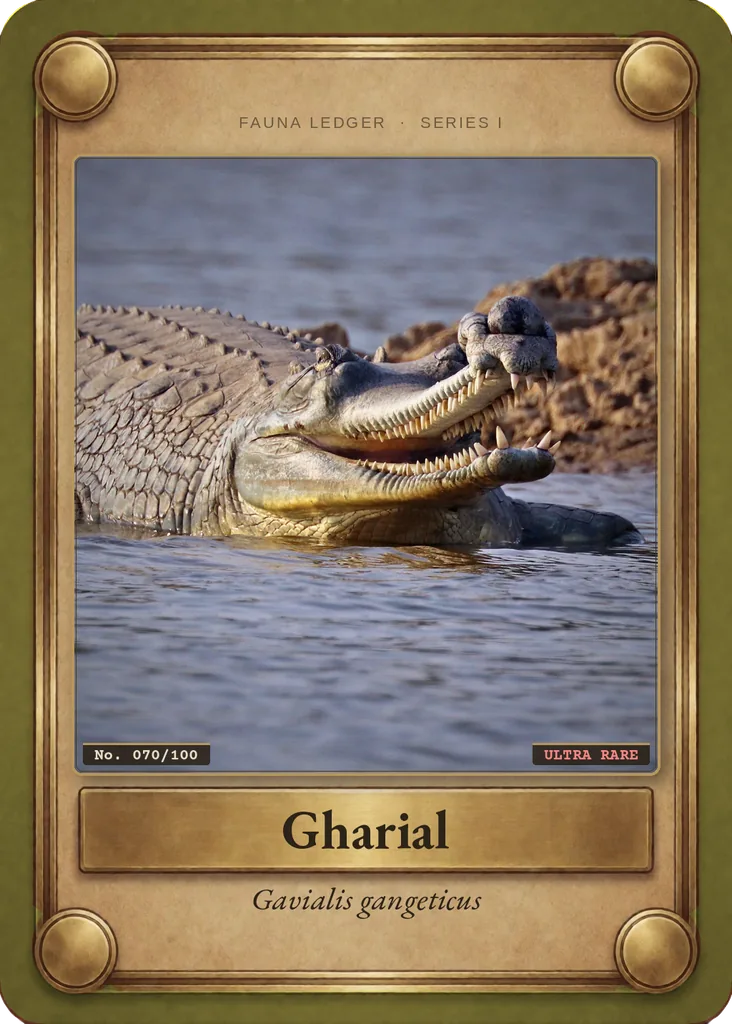
Only adult males grow the ghara, a knob on the snout named for an Indian clay pot. Hydrophones on the Chambal found that only males with one make a loud underwater pop, heard 500 m away.
Fewer than a thousand adults are left. The 2019 Red List assessment put the wild population at about 650 adults, roughly three in four of them on one river, the Chambal, after a crash of more than 90% between 1946 and 2006.
Each male's pops have their own rhythm. A 2025 study in the Journal of Anatomy recorded seven wild males on the Chambal over three years and could tell every one apart by the timing of his pops, a pattern that held steady from one year to the next.
Its snout is the slenderest of any living crocodilian, lined with more than 100 small interlocking teeth. It is built for quick sideways snaps at fish, and adults eat almost nothing else.
India's first captive-hatched gharial came out of its egg on 18 June 1975 at a project in Odisha. It began decades of rearing young from wild-collected eggs and releasing them into protected rivers.
It once lived across the Indus, Ganges, Brahmaputra and Mahanadi river systems and is now gone from Bhutan and Myanmar. In 2023 WWF-Pakistan confirmed gharials in Pakistan's Punjab for the first time in about 30 years, possibly animals that came downstream from a reintroduction in India.
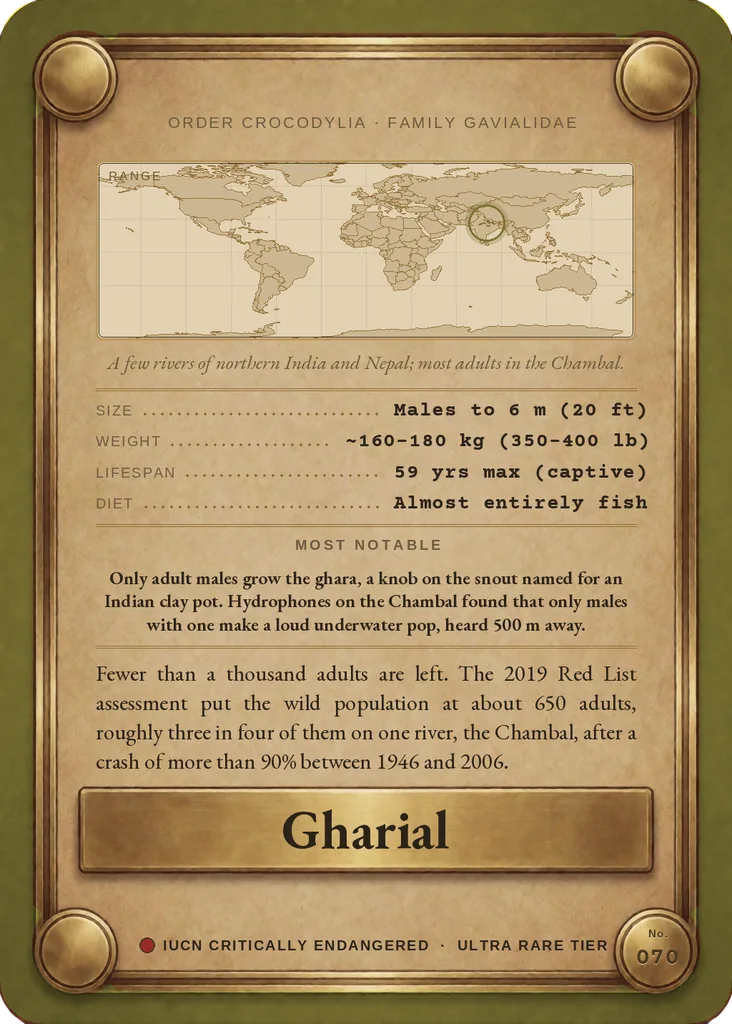
The map shows the rivers that hold the main wild populations: the Chambal, the Son, the Girwa and Ghaghara, the Gandak, the Ramganga, and in Nepal the Narayani, Rapti, Karnali and Babai. Small reintroduced groups elsewhere are not drawn.
Range: A few rivers of northern India and Nepal; most adults in the Chambal.