
Card #066 · Reptiles
King cobra
Ophiophagus hannah
Rare VU · Vulnerable
Field notes
- Classification
- Order Squamata · Family Elapidae
- Range
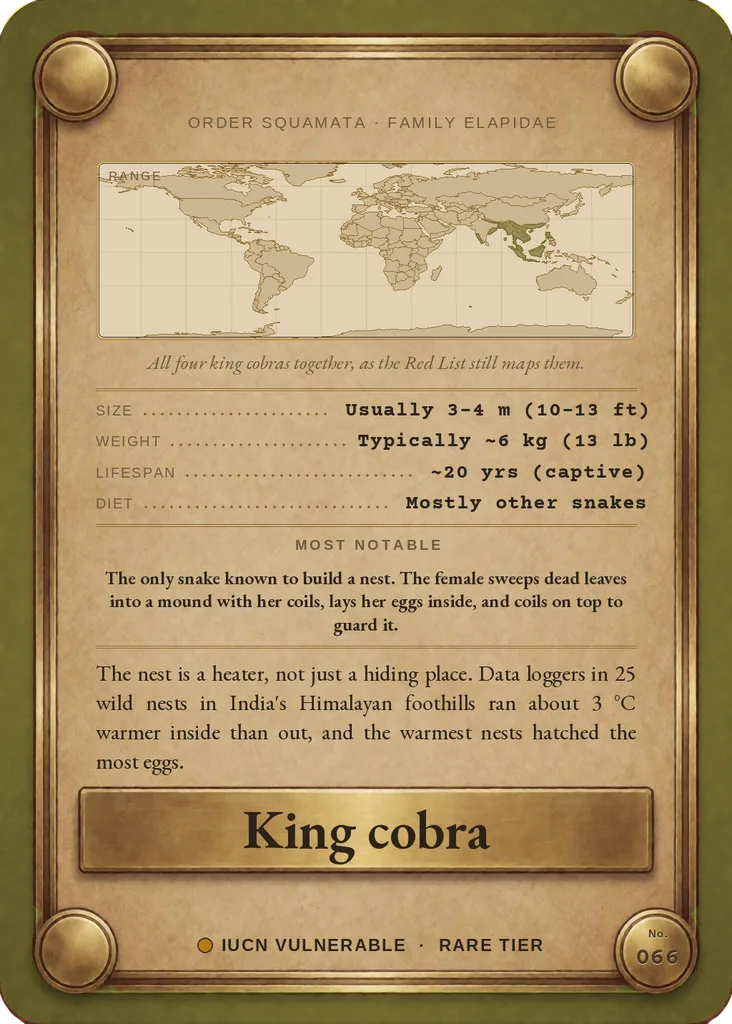
- India and southern China to Indonesia and the Philippines
- Size
- Usually 3–4 m (10–13 ft)
- Weight
- Typically ~6 kg (13 lb)
- Lifespan
- ~20 yrs (captive)
- Diet
- Mostly other snakes
Most Notable
The only snake known to build a nest. The female sweeps dead leaves into a mound with her coils, lays her eggs inside, and coils on top to guard it.
The nest is a heater, not just a hiding place. Data loggers in 25 wild nests in India's Himalayan foothills ran about 3 °C warmer inside than out, and the warmest nests hatched the most eggs.
The longest venomous snake ever measured was a king cobra caught near Port Dickson, Malaysia, in 1937. It reached 5.71 metres at London Zoo and was destroyed when war broke out in 1939, along with the zoo's other venomous animals, in case bombing let them loose.
Its genus name, Ophiophagus, means snake eater. Most of what it hunts is other snakes, rat snakes and kraits among them, and sometimes other king cobras.
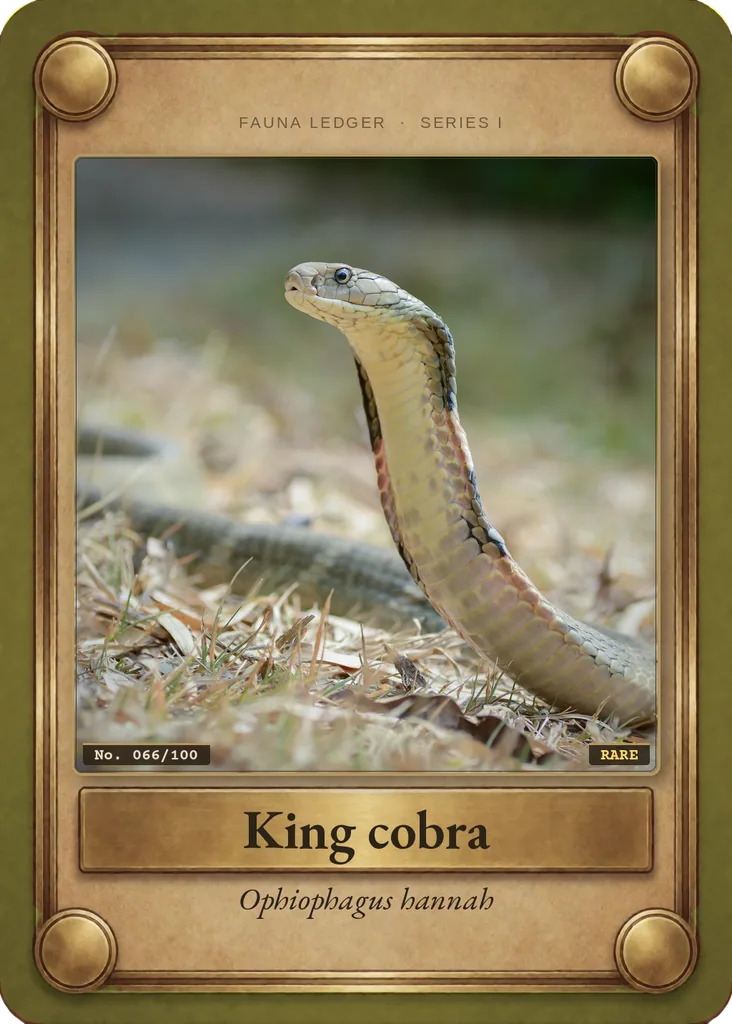
In 2024 a taxonomic revision split the king cobra into four species: the northern king cobra (Ophiophagus hannah, the one in this photograph, from Thailand's Kaeng Krachan National Park), the Sunda king cobra (O. bungarus), the Western Ghats king cobra (O. kaalinga) and the Luzon king cobra (O. salvatana). By that reckoning the 1937 record snake was a Sunda king cobra.
The Red List has not yet assessed the four separately. Its Vulnerable listing covers all of them together, so that is what the badge and the map show. The two small-range species, in the Western Ghats and on Luzon, may well prove to be in more trouble when they are assessed on their own.
Females do not always see the eggs through. Guarding has been recorded for anywhere from two to 77 days against an incubation of two to three and a half months, so many leave before the hatchlings emerge.
Range: All four king cobras together, as the Red List still maps them.