
Card #064 · Reptiles
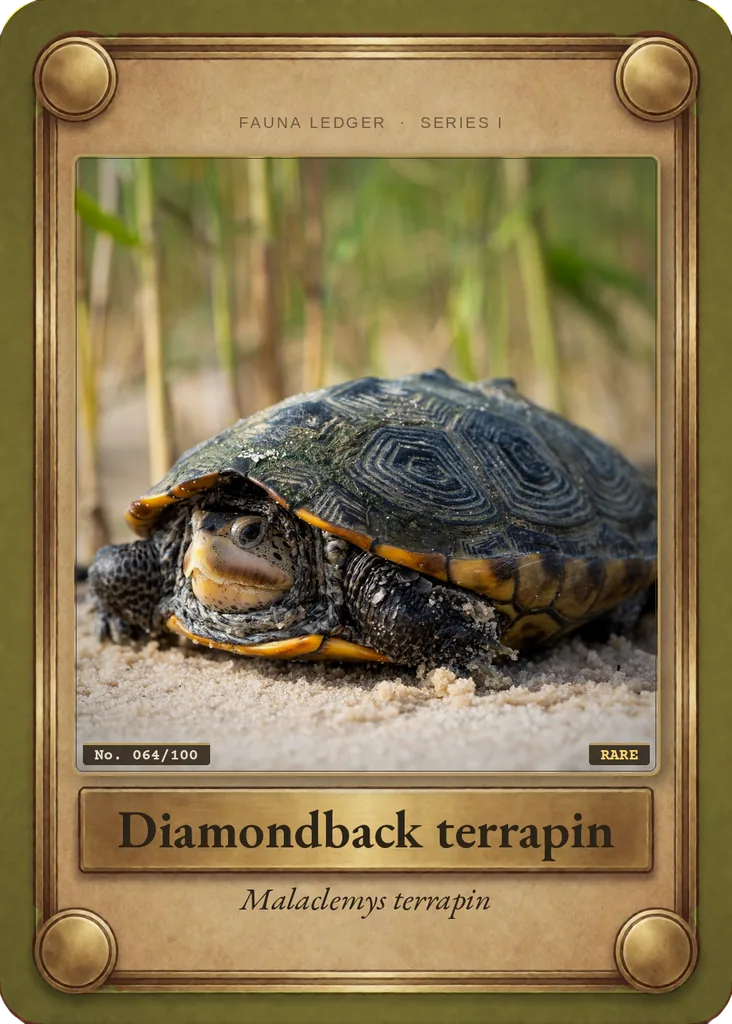
Diamondback terrapin
Malaclemys terrapin
Rare VU · Vulnerable
Field notes
- Classification
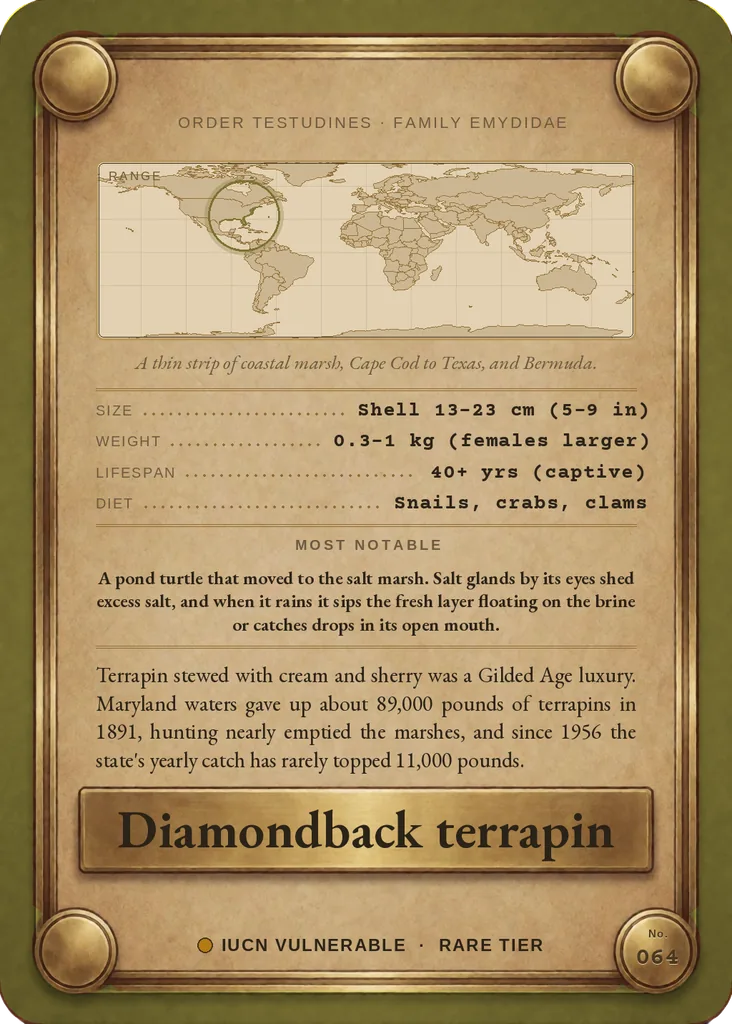
- Order Testudines · Family Emydidae
- Range
- Salt marshes of the US Atlantic and Gulf coasts, and Bermuda
- Size
- Shell 13–23 cm (5–9 in)
- Weight
- 0.3–1 kg (females larger)
- Lifespan
- 40+ yrs (captive)
- Diet
- Snails, crabs, clams
Most Notable
A pond turtle that moved to the salt marsh. Salt glands by its eyes shed excess salt, and when it rains it sips the fresh layer floating on the brine or catches drops in its open mouth.
Terrapin stewed with cream and sherry was a Gilded Age luxury. Maryland waters gave up about 89,000 pounds of terrapins in 1891, hunting nearly emptied the marshes, and since 1956 the state's yearly catch has rarely topped 11,000 pounds.
Vulnerable is the global status, set in the 2019 IUCN assessment; the species was previously listed as Near Threatened. Its seven subspecies are not assessed separately. Locally it fares worse: it is listed Endangered in Rhode Island and Threatened in Massachusetts, and Bermuda protects its tiny population by law.
It is often called the only turtle in the world that lives in brackish water. It is not: several Asian river terrapins live in estuaries too, and this one can survive in fresh water or full seawater. What is true is that it is the only North American turtle that makes the salt marsh its home.
Crab pots are its biggest modern threat. Terrapins swim in after the same bait and drown. In one Georgia marsh, two abandoned pots held 133 dead terrapins. Cheap excluder rings keep them out with little effect on the crab catch, and New Jersey, Delaware and Maryland require them.
In July 2009 a runway at JFK airport in New York was shut while workers collected 78 terrapins that had wandered onto it in nesting season, and flight delays reached about an hour and a half.
The Bermuda terrapins are native. Fossils and genetics suggest they reached the island on their own, probably carried by the Gulf Stream, sometime between 3,000 and 400 years ago. Today they are restricted to two mangrove ponds.
Range: A thin strip of coastal marsh, Cape Cod to Texas, and Bermuda.