
Card #055 · Reptiles
Green iguana
Iguana iguana
Common LC · Least Concern
Field notes
- Classification
- Order Squamata · Family Iguanidae
- Range
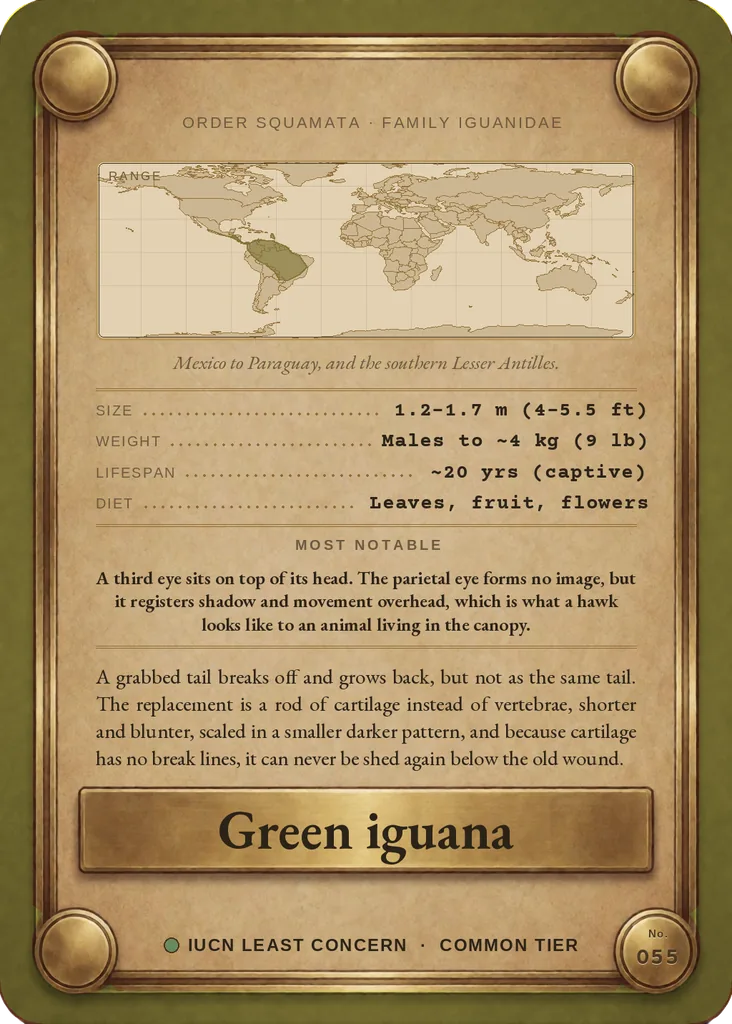
- Mexico to Paraguay, and the southern Lesser Antilles
- Size
- 1.2–1.7 m (4–5.5 ft)
- Weight
- Males to ~4 kg (9 lb)
- Lifespan
- ~20 yrs (captive)
- Diet
- Leaves, fruit, flowers
Most Notable
A third eye sits on top of its head. The parietal eye forms no image, but it registers shadow and movement overhead, which is what a hawk looks like to an animal living in the canopy.
A grabbed tail breaks off and grows back, but not as the same tail. The replacement is a rod of cartilage instead of vertebrae, shorter and blunter, scaled in a smaller darker pattern, and because cartilage has no break lines, it can never be shed again below the old wound.
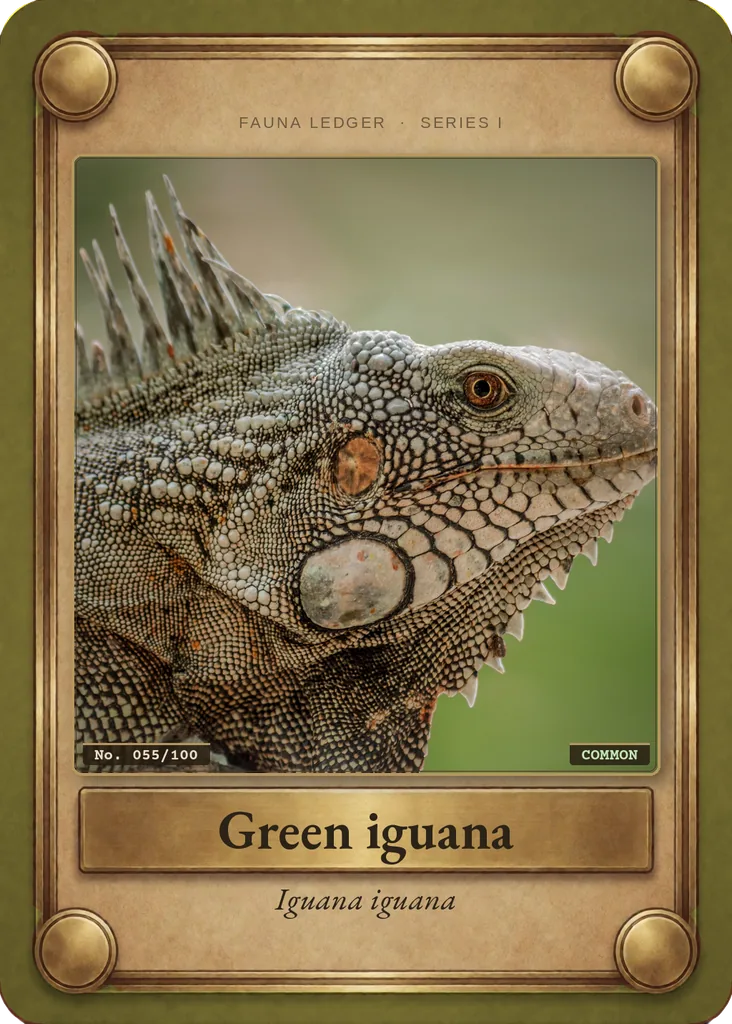
The big round plate under its ear is a scale, not an eardrum. The subtympanic plate and the heavy jowls around it are male features, which is how you can read this animal's sex from the photograph.
It can fall 15 metres and walk away. Green iguanas live high in riverside trees and drop rather than climb down when something startles them, often into the water.
It was nearly split into three species. Proposals to raise the melanistic Caribbean populations to Iguana melanoderma and the Grenadines and St Lucia animals to Iguana insularis were not adopted by the IUCN's Iguana Taxonomic Working Group, which keeps them inside Iguana iguana.
This map is the native range only. Green iguanas are also established in Florida, Hawaii, Texas, Taiwan and Fiji, where they were introduced and are not drawn here.
Range: Mexico to Paraguay, and the southern Lesser Antilles.