
Card #053 · Birds
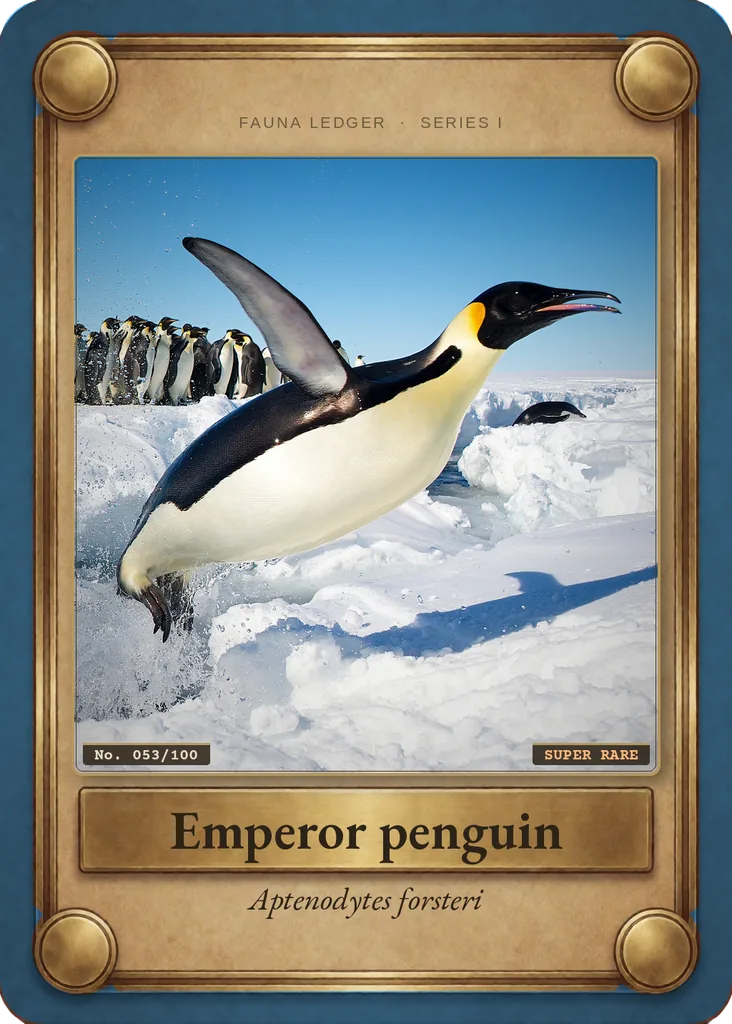
Emperor penguin
Aptenodytes forsteri
Super Rare EN · Endangered
Field notes
- Classification
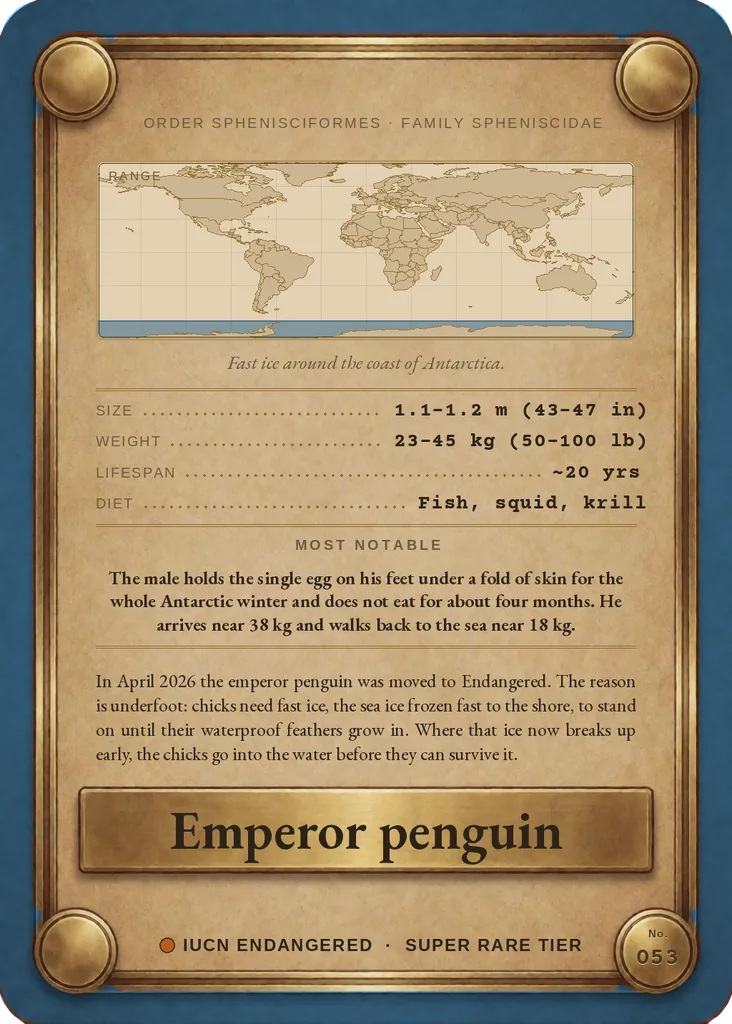
- Order Sphenisciformes · Family Spheniscidae
- Range
- Coastal Antarctica
- Size
- 1.1–1.2 m (43–47 in)
- Weight
- 23–45 kg (50–100 lb)
- Lifespan
- ~20 yrs
- Diet
- Fish, squid, krill
Most Notable
The male holds the single egg on his feet under a fold of skin for the whole Antarctic winter and does not eat for about four months. He arrives near 38 kg and walks back to the sea near 18 kg.
In April 2026 the emperor penguin was moved to Endangered. The reason is underfoot: chicks need fast ice, the sea ice frozen fast to the shore, to stand on until their waterproof feathers grow in. Where that ice now breaks up early, the chicks go into the water before they can survive it.
It is the only bird that breeds through the Antarctic winter, and the only one that never sets foot on land. The whole cycle happens on sea ice.
The huddle is how they survive it. Thousands of males pack together at up to ten birds per square metre, and the huddle moves in a slow shuffle that rotates birds from the freezing edge to the warm centre and back out again. Nobody stays on the outside.
They dive deeper than any other bird. The record is 564 m, well beyond the reach of daylight, and a hunting bird can stay under for more than twenty minutes.
About 595,000 adults were counted across 66 known colonies. Satellites recorded roughly a tenth of them gone between 2009 and 2018, more than 20,000 birds, and current projections halve the population by the 2080s.
Range: Fast ice around the coast of Antarctica.