
Card #046 · Birds
Snowy owl
Bubo scandiacus
Rare VU · Vulnerable
Field notes
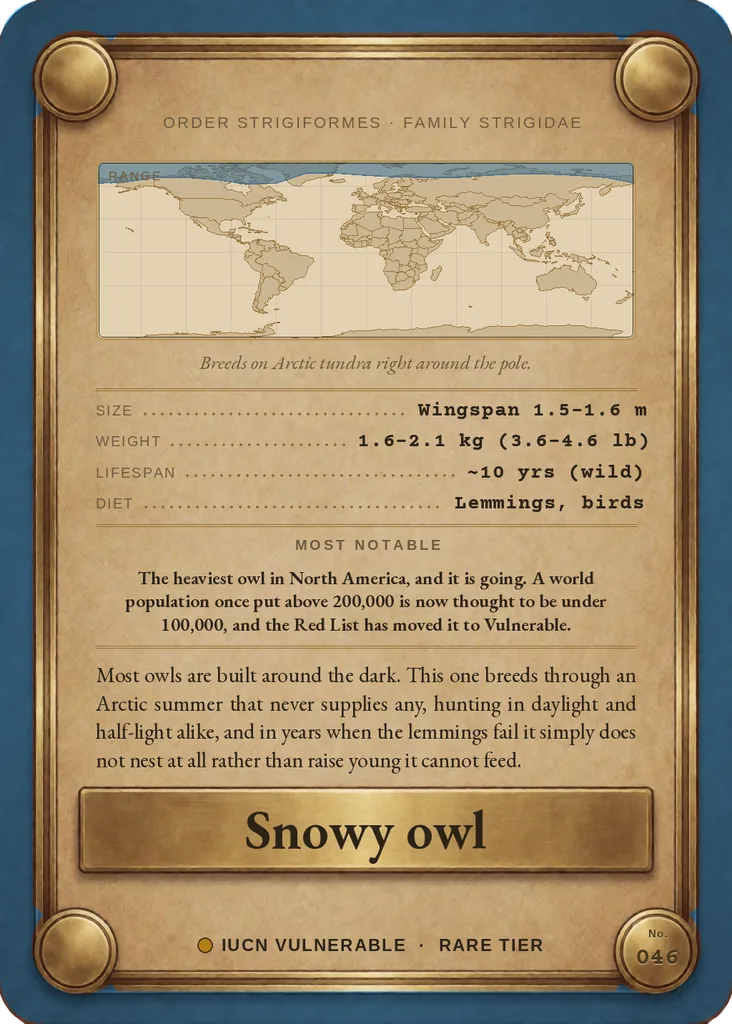
- Classification
- Order Strigiformes · Family Strigidae
- Range
- Arctic tundra, circumpolar
- Size
- Wingspan 1.5–1.6 m
- Weight
- 1.6–2.1 kg (3.6–4.6 lb)
- Lifespan
- ~10 yrs (wild)
- Diet
- Lemmings, birds
Most Notable
The heaviest owl in North America, and it is going. A world population once put above 200,000 is now thought to be under 100,000, and the Red List has moved it to Vulnerable.
Most owls are built around the dark. This one breeds through an Arctic summer that never supplies any, hunting in daylight and half-light alike, and in years when the lemmings fail it simply does not nest at all rather than raise young it cannot feed.
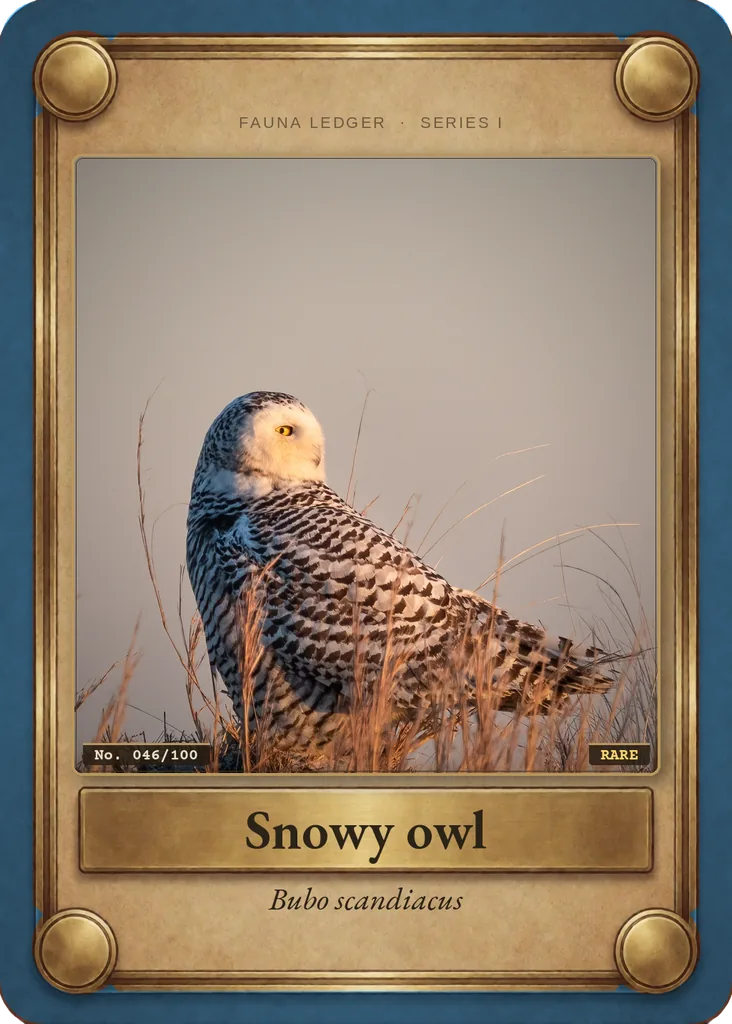
The bird in this photograph is a wild one on a Long Island beach, not a bird of the far north seen at home. In some winters snowy owls pour south in numbers, and 2011 and 2013 put them on dunes, airfields and breakwaters as far as the Gulf Coast.
They wander enormously even within a winter. Owls tracked from the Kola Peninsula averaged nearly a thousand kilometres of movement across a single wintering period, which is closer to nomadism than migration.
The female is the larger bird and the darker one. Males pale as they age, so the whitest owls tend to be old males and the heavily barred ones are females and young birds.
Nobody is confident about why it is declining. The drop is real and steep, and the causes are a tangle of changing Arctic prey cycles, collisions and poisoning on the wintering grounds, none of which alone accounts for it.
Range: Breeds on Arctic tundra right around the pole.