
Card #040 · Birds
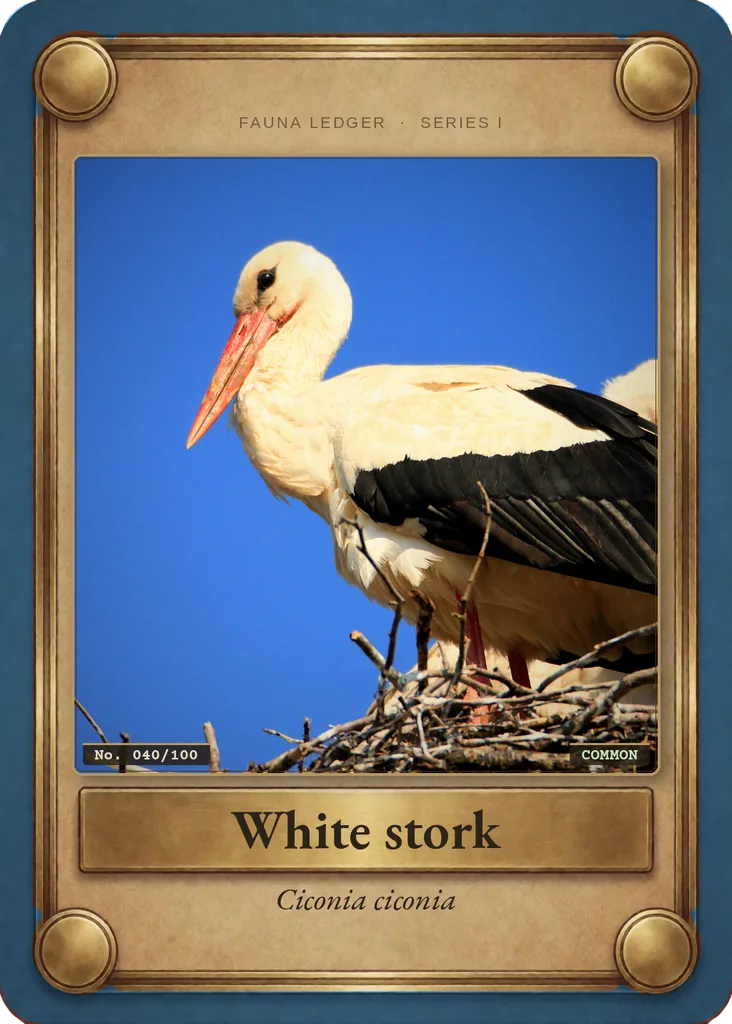
White stork
Ciconia ciconia
Common LC · Least Concern
Field notes
- Classification
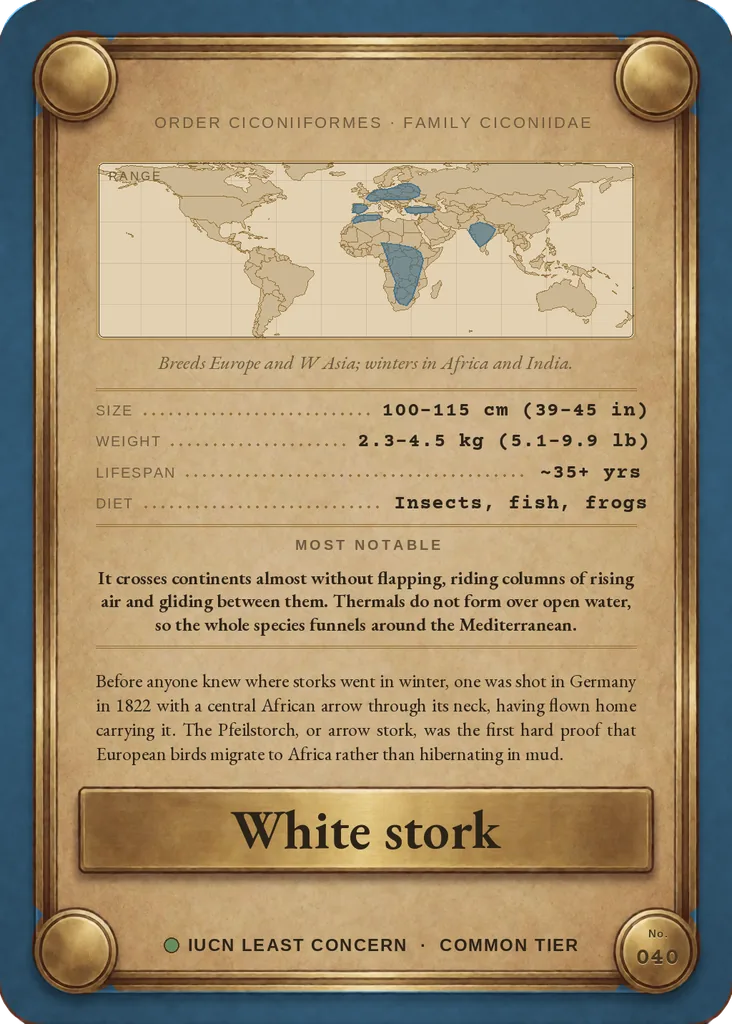
- Order Ciconiiformes · Family Ciconiidae
- Range
- Europe, Middle East, Africa (migratory)
- Size
- 100–115 cm (39–45 in)
- Weight
- 2.3–4.5 kg (5.1–9.9 lb)
- Lifespan
- ~35+ yrs
- Diet
- Insects, fish, frogs
Most Notable
It crosses continents almost without flapping, riding columns of rising air and gliding between them. Thermals do not form over open water, so the whole species funnels around the Mediterranean.
Before anyone knew where storks went in winter, one was shot in Germany in 1822 with a central African arrow through its neck, having flown home carrying it. The Pfeilstorch, or arrow stork, was the first hard proof that European birds migrate to Africa rather than hibernating in mud.
The legend that storks bring babies is very old, but it was Hans Christian Andersen's 19th-century story 'The Storks' that fixed it in the popular imagination.
Because it is treated as a good omen rather than persecuted, it nests openly on roofs, chimneys and poles in the middle of towns, and is the national bird of Lithuania, Belarus and Poland.
The oldest known wild white stork was still flying 39 years after it was ringed in Switzerland.
Range: Breeds Europe and W Asia; winters in Africa and India.