
Card #039 · Birds
Roseate spoonbill
Platalea ajaja
Common LC · Least Concern
Field notes
- Classification
- Order Pelecaniformes · Family Threskiornithidae
- Range
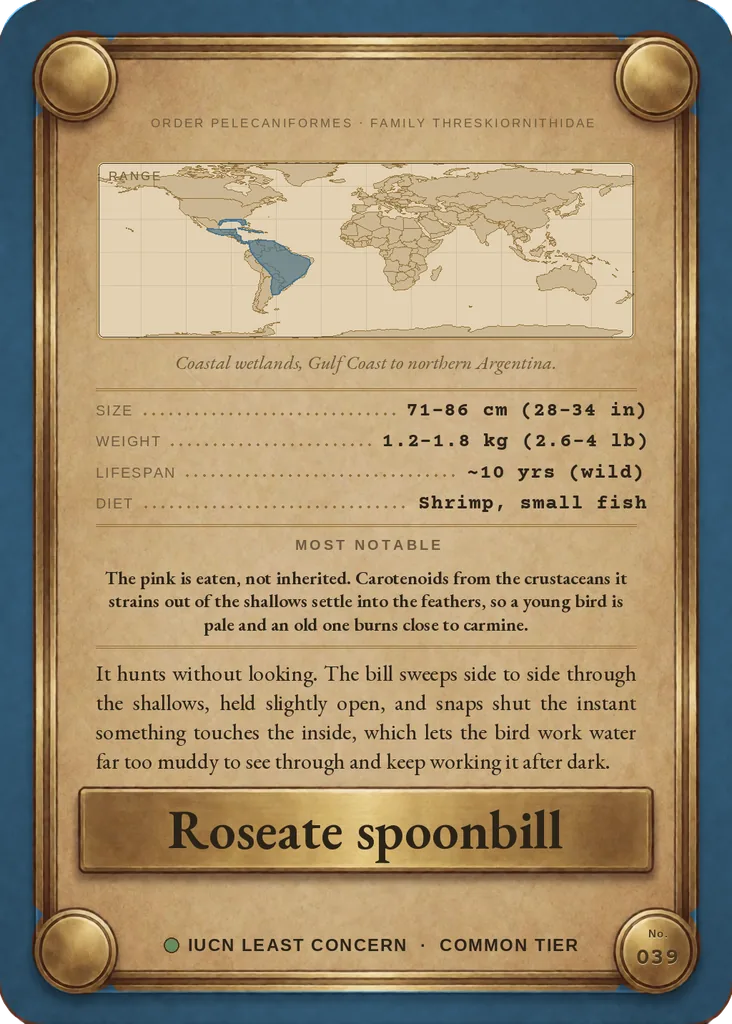
- Coastal wetlands of the Americas
- Size
- 71–86 cm (28–34 in)
- Weight
- 1.2–1.8 kg (2.6–4 lb)
- Lifespan
- ~10 yrs (wild)
- Diet
- Shrimp, small fish
Most Notable
The pink is eaten, not inherited. Carotenoids from the crustaceans it strains out of the shallows settle into the feathers, so a young bird is pale and an old one burns close to carmine.
It hunts without looking. The bill sweeps side to side through the shallows, held slightly open, and snaps shut the instant something touches the inside, which lets the bird work water far too muddy to see through and keep working it after dark.
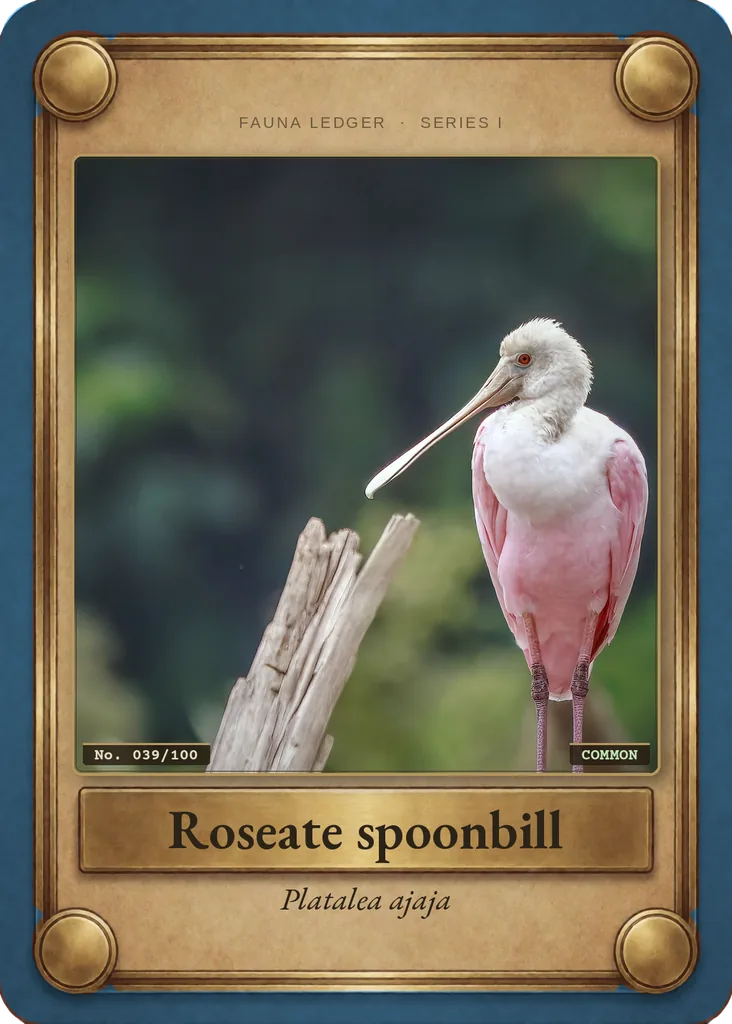
The bird in this photograph is a young adult, which is why the pink is soft. Full colour takes about three years, and the deepest carmine belongs to old birds in breeding condition.
Plume hunters very nearly finished it. Spoonbill wings were cut up for ladies' fans in the eighteenth and nineteenth centuries, and by the 1930s a few dozen nesting pairs were left in the United States. The Least Concern badge on this card is the end of a recovery, not an absence of history.
The bill arrives late. Chicks hatch with a short straight bill and the spoon grows into shape over the first weeks, which is roughly the order in which the young bird learns to use it.
It is spreading north. Spoonbills now nest well up the Atlantic seaboard beyond their old Gulf range, and the expansion is being watched as a warm-water indicator rather than simply good news.
Range: Coastal wetlands, Gulf Coast to northern Argentina.