
Card #036 · Birds
Blue-and-yellow macaw
Ara ararauna
Common LC · Least Concern
Field notes
- Classification
- Order Psittaciformes · Family Psittacidae
- Range
- Eastern Panama to Bolivia, Paraguay and Brazil; reintroduced to Trinidad
- Size
- 76–86 cm (30–34 in)
- Weight
- ~1 kg (2 lb 4 oz)
- Lifespan
- To 43 yrs (captive)
- Diet
- Seeds, fruit, nuts
Most Notable
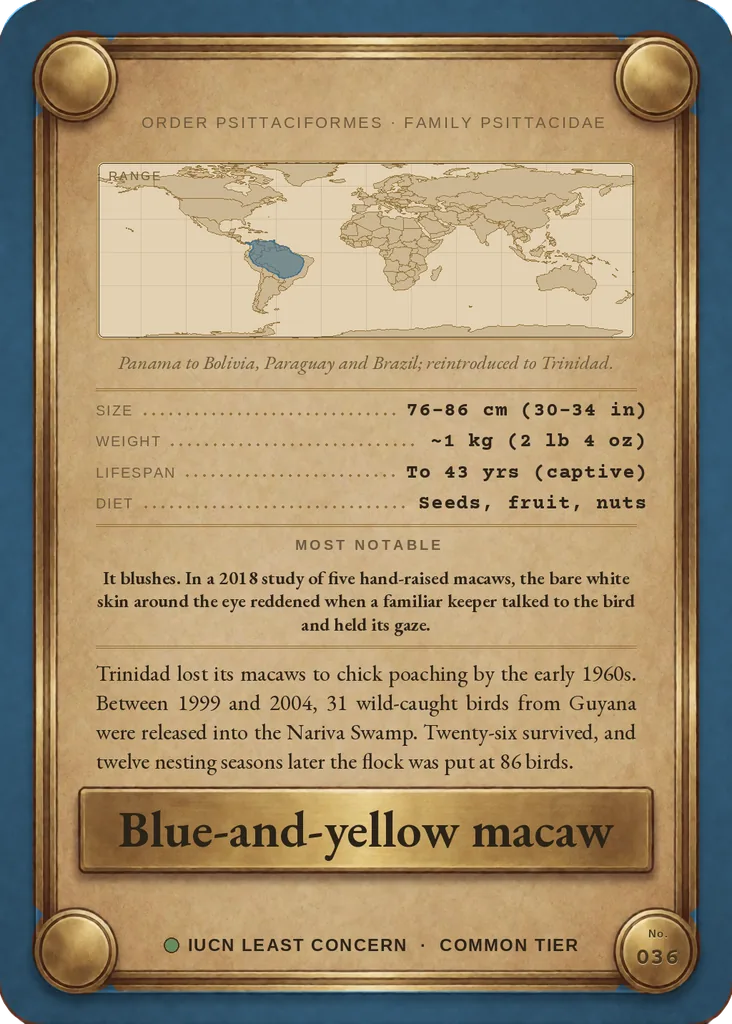
It blushes. In a 2018 study of five hand-raised macaws, the bare white skin around the eye reddened when a familiar keeper talked to the bird and held its gaze.
Trinidad lost its macaws to chick poaching by the early 1960s. Between 1999 and 2004, 31 wild-caught birds from Guyana were released into the Nariva Swamp. Twenty-six survived, and twelve nesting seasons later the flock was put at 86 birds.
The blushing study also found the crown feathers rose during those close exchanges with the keeper, and ruffled most while the birds sat still, resting or chewing. The authors note blushing is not reported in the red-and-green macaw, which shares much of its range.
It does have a bone in its tongue, like every parrot, and the thick muscular tongue works with the hooked bill to turn and hold seeds while they are cracked. The popular line that it tests fruit for ripeness with that bone has no source we could find, so it is not on this card.
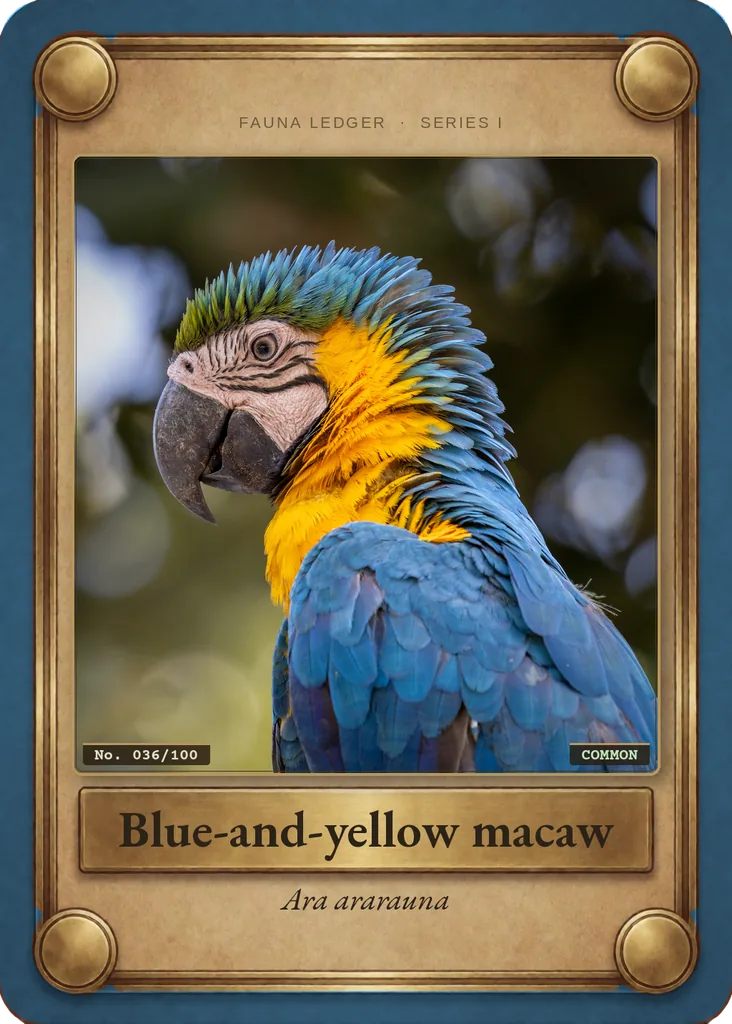
The bird on this card is wild, photographed in Brazil's Pantanal Matogrossense National Park with its crown feathers raised. Look closely at the face and you can see the lines are made of feathers, set in bare wrinkled skin.
The black lines across its white face are rows of tiny feathers. You will often read that the pattern is unique to each bird like a fingerprint, but that is documented for its critically endangered relative the blue-throated macaw, not for this species.
Least Concern, but declining. The 2018 Red List assessment keeps it off the threatened list because its range is so large, while trapping for the pet trade and forest clearance keep shrinking it.
This map is the native range, including Trinidad, where the reintroduced flock now lives. Feral populations in Florida and Puerto Rico descend from escaped pets and are not drawn.
Range: Panama to Bolivia, Paraguay and Brazil; reintroduced to Trinidad.