
Card #030 · Mammals
Thylacine (Tasmanian tiger)
Thylacinus cynocephalus
Legendary EX · Extinct
Field notes
- Classification
- Order Dasyuromorphia · Family Thylacinidae
- Range
- Tasmania, Australia (gone from mainland Australia and New Guinea about 3,200 years ago)
- Size
- 1–1.3 m long, plus tail
- Weight
- Avg ~17 kg (37 lb)
- Lifespan
- Up to ~9 yrs (captive)
- Diet
- Wallabies, possums, birds
Most Notable
On 7 September 1936 the last known thylacine died at Hobart's Beaumaris Zoo, just 59 days after Tasmania finally made the species legally protected.
It is often called Benjamin, but that name first appeared in 1968, from a man with no record of working at the zoo. In 2022 researchers traced the last thylacine to an old female, snared in the Florentine Valley and sold to the zoo in May 1936.
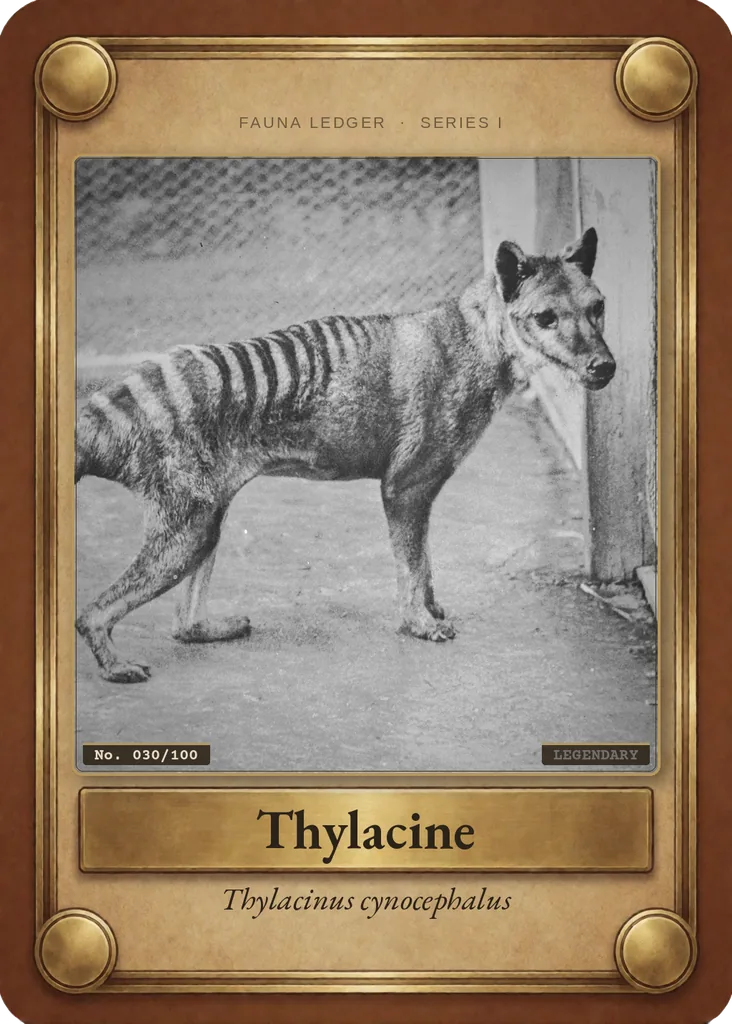
It was a marsupial, not a dog. The wolf-like skull and build evolved separately from the dogs', and its closest living relatives are the Tasmanian devil, the quolls and the numbat. Unusually, both sexes had a pouch: the female's opened to the rear, and the male's sheltered his scrotum.
Tasmania paid a government bounty of £1 per adult from 1888 to 1909, and the state's records show 2,184 bounties paid. Private bounties, habitat loss and dogs added to the toll.
The name Benjamin traces to a 1968 claim by Frank Darby, whom zoo records do not show as a keeper. In 2022 Robert Paddle and Kathryn Medlock showed the last thylacine was an elderly female, whose skin and skeleton had sat unrecognised in the Tasmanian Museum and Art Gallery.
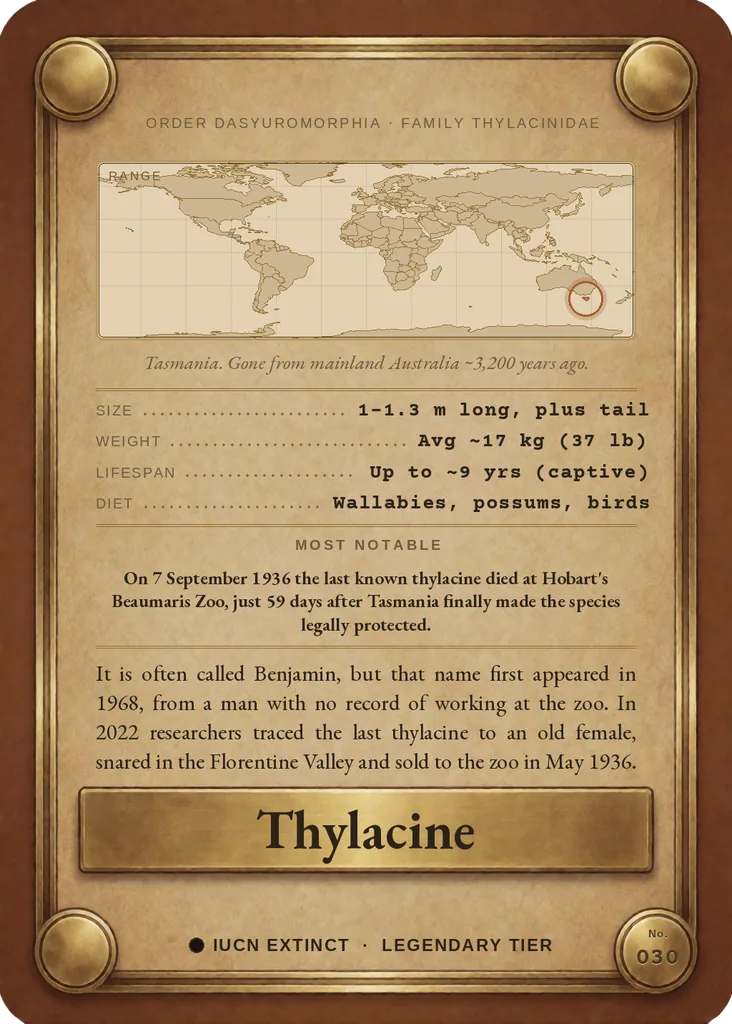
The map shows Tasmania only. Thylacines once lived across mainland Australia and New Guinea, but were gone from the mainland about 3,200 years ago.
The IUCN lists the thylacine as Extinct. A 2023 study by Barry Brook and colleagues weighed 1,237 reported sightings since 1910 and suggested it may have lingered in Tasmania's remote southwest into the late 1980s or later. No specimen, photo or film has confirmed one alive since 1936.
In 2023 researchers recovered RNA from a thylacine kept at the Swedish Museum of Natural History since 1891, the first gene-activity profile read from an extinct animal.
Every photograph of a live thylacine shows a captive animal. This one was taken at Beaumaris Zoo in 1936.
Range: Tasmania. Gone from mainland Australia ~3,200 years ago.