
Card #029 · Mammals
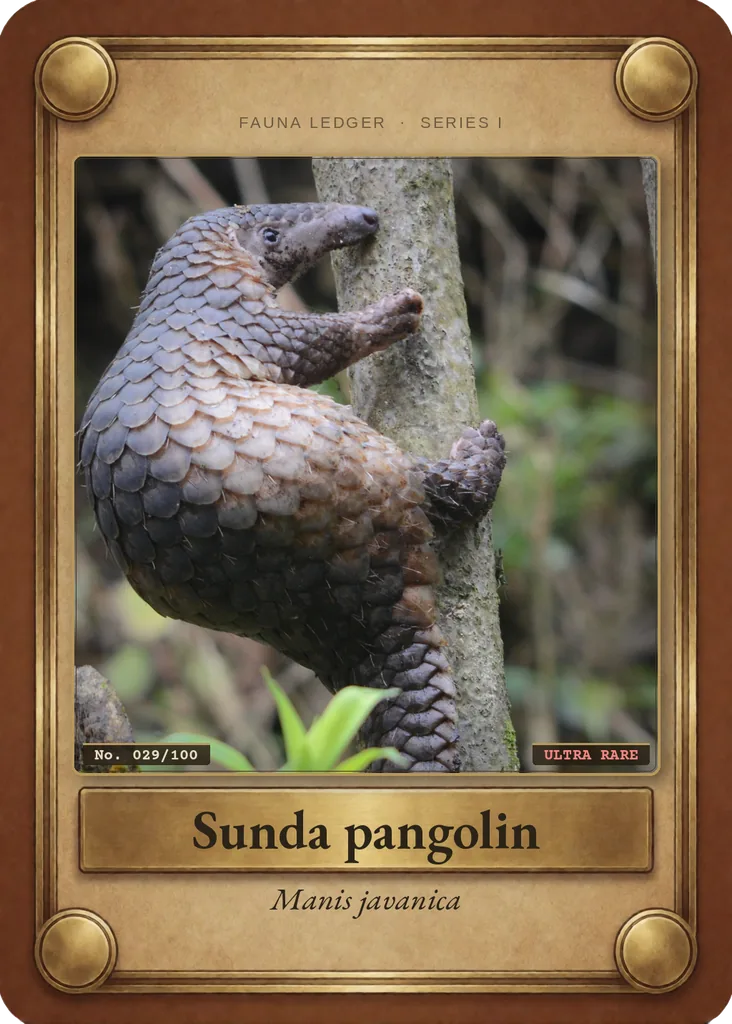
Sunda pangolin
Manis javanica
Ultra Rare CR · Critically Endangered
Field notes
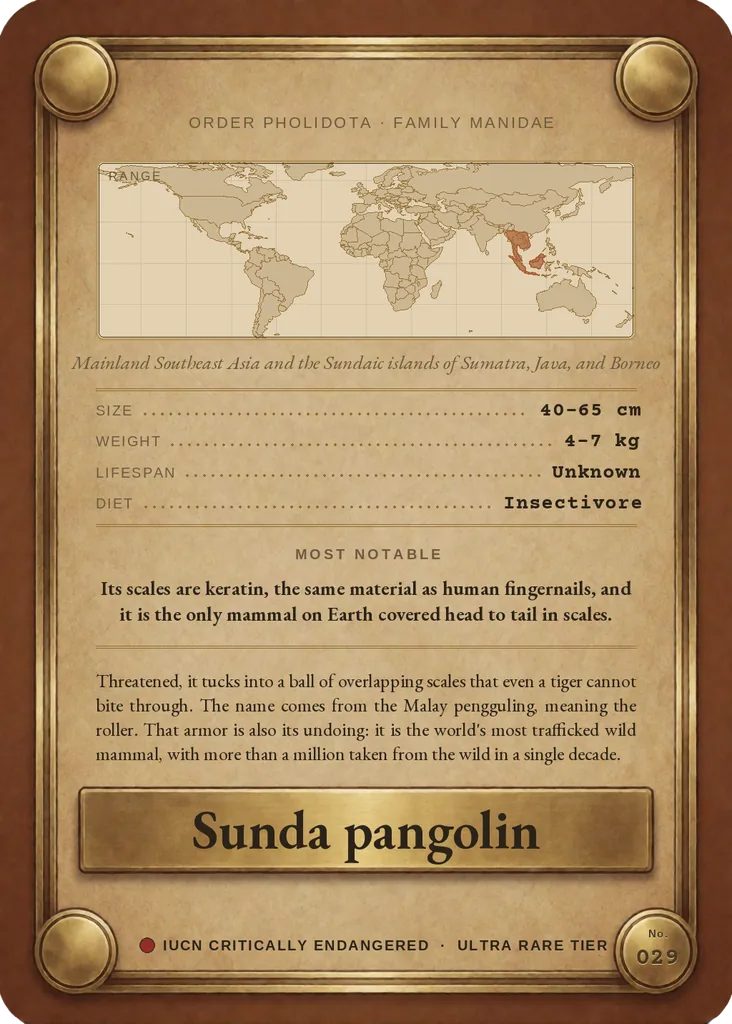
- Classification
- Order Pholidota · Family Manidae
- Range
- Southeast Asia
- Size
- 40–65 cm
- Weight
- 4–7 kg
- Lifespan
- Unknown
- Diet
- Insectivore
Most Notable
Its scales are keratin, the same material as human fingernails, and it is the only mammal on Earth covered head to tail in scales.
Threatened, it tucks into a ball of overlapping scales that even a tiger cannot bite through. The name comes from the Malay pengguling, meaning the roller. That armor is also its undoing: it is the world's most trafficked wild mammal, with more than a million taken from the wild in a single decade.
A pangolin has no teeth. It feeds with a tongue longer than its own body, anchored not in the mouth but deep in the chest near the pelvis, flicking it through ant and termite nests to lap up an estimated 70 million insects a year and grinding them in a muscular, stone-filled stomach.
The Sunda pangolin is the most tree-loving of the Asian pangolins, a nimble climber that grips bark with long digging claws and a prehensile tail, and it often shelters in tree hollows rather than digging deep burrows.
A mother carries her single pup on the base of her tail, where it rides along as she forages through the night.
The scales are only keratin, the stuff of fingernails, with no proven medicinal value, yet demand for them in traditional medicine, alongside demand for the meat, drives the trade that has pushed all eight pangolin species toward extinction.
Range: Mainland Southeast Asia and the Sundaic islands of Sumatra, Java, and Borneo