
Card #023 · Mammals
Reindeer (caribou)
Rangifer tarandus
Rare VU · Vulnerable
Field notes
- Classification
- Order Artiodactyla · Family Cervidae
- Range
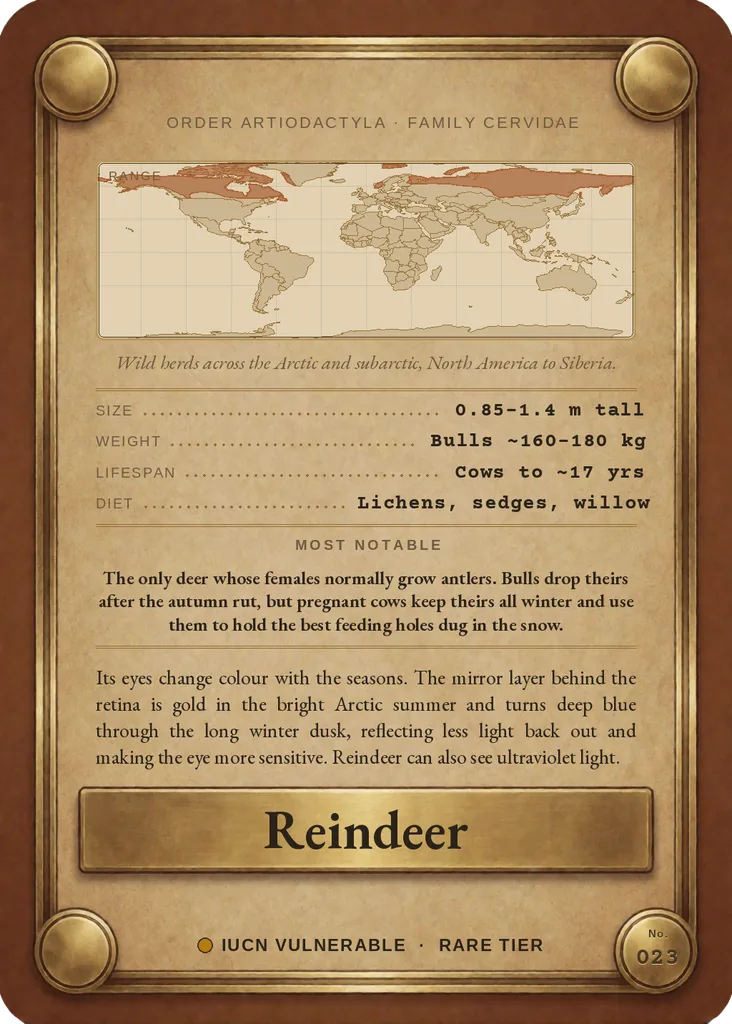
- Arctic and subarctic tundra and taiga: North America, Greenland, Scandinavia and Russia
- Size
- 0.85–1.4 m tall
- Weight
- Bulls ~160–180 kg
- Lifespan
- Cows to ~17 yrs
- Diet
- Lichens, sedges, willow
Most Notable
The only deer whose females normally grow antlers. Bulls drop theirs after the autumn rut, but pregnant cows keep theirs all winter and use them to hold the best feeding holes dug in the snow.
Its eyes change colour with the seasons. The mirror layer behind the retina is gold in the bright Arctic summer and turns deep blue through the long winter dusk, reflecting less light back out and making the eye more sensitive. Reindeer can also see ultraviolet light.
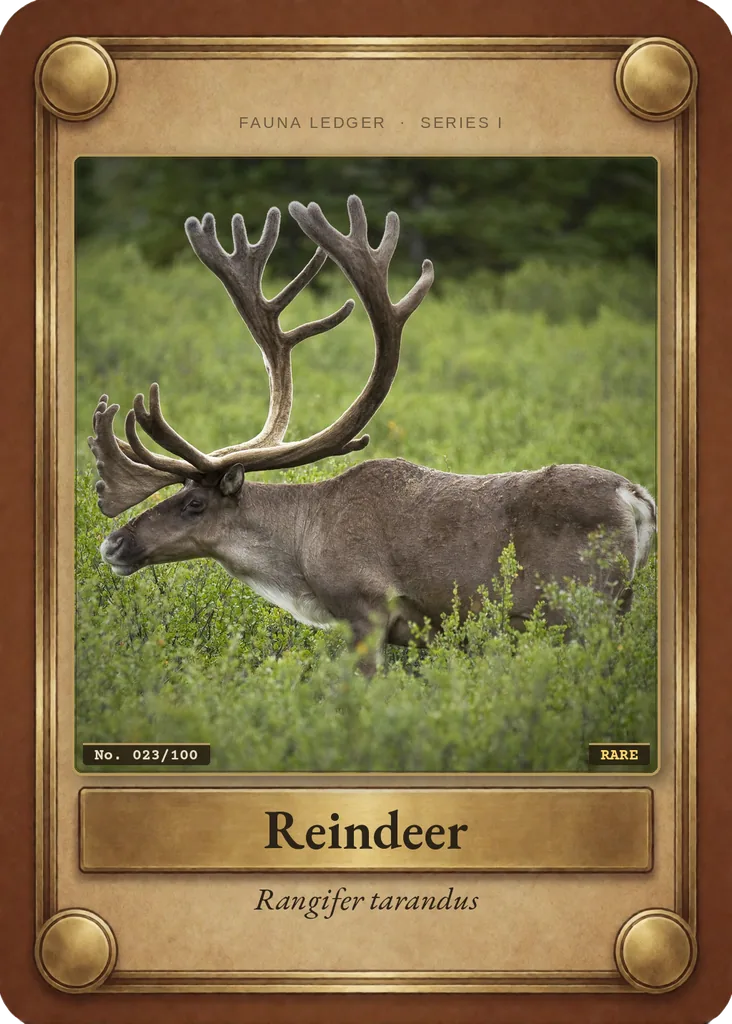
Reindeer and caribou are the same species, Rangifer tarandus. Caribou is the North American name; in Europe and Asia it is reindeer, and many of those animals are herded. The bull on this card is a wild caribou, photographed in Denali National Park, Alaska, in August 2012.
Vulnerable on the IUCN Red List (2016 assessment): wild numbers fell by about 40 percent in roughly 25 years, from some 4.8 million to about 2.9 million. Some herds fell much further. The George River herd of Quebec and Labrador went from about 776,000 in 1993 to under 9,000 by 2016.
In 2022 a Canadian mammalogist proposed splitting Rangifer into six species. Neither the IUCN nor the Mammal Diversity Database has adopted it, so this card follows the single species the Red List actually assessed.
They are champion walkers. A 2019 review of GPS-collar studies found caribou of the Bathurst and Porcupine herds making round-trip migrations of up to about 1,350 km, likely the longest of any land animal.
The map shows wild herds only. Semi-domestic reindeer herded across northern Scandinavia and Russia, and introduced herds such as Iceland's, are not drawn.
Range: Wild herds across the Arctic and subarctic, North America to Siberia.