
Card #022 · Mammals
Dugong
Dugong dugon
Rare VU · Vulnerable
Field notes
- Classification
- Order Sirenia · Family Dugongidae
- Range
- Shallow coastal waters of the Indo-Pacific
- Size
- 2.4–3 m (7.9–9.8 ft)
- Weight
- 250–400 kg (550–880 lb)
- Lifespan
- Up to 70 yrs
- Diet
- Seagrass
Most Notable
It is the only mammal that lives its whole life in the sea and eats nothing but plants. Manatees graze too, but they run up into rivers. The dugong never leaves salt water, and never leaves the seagrass.
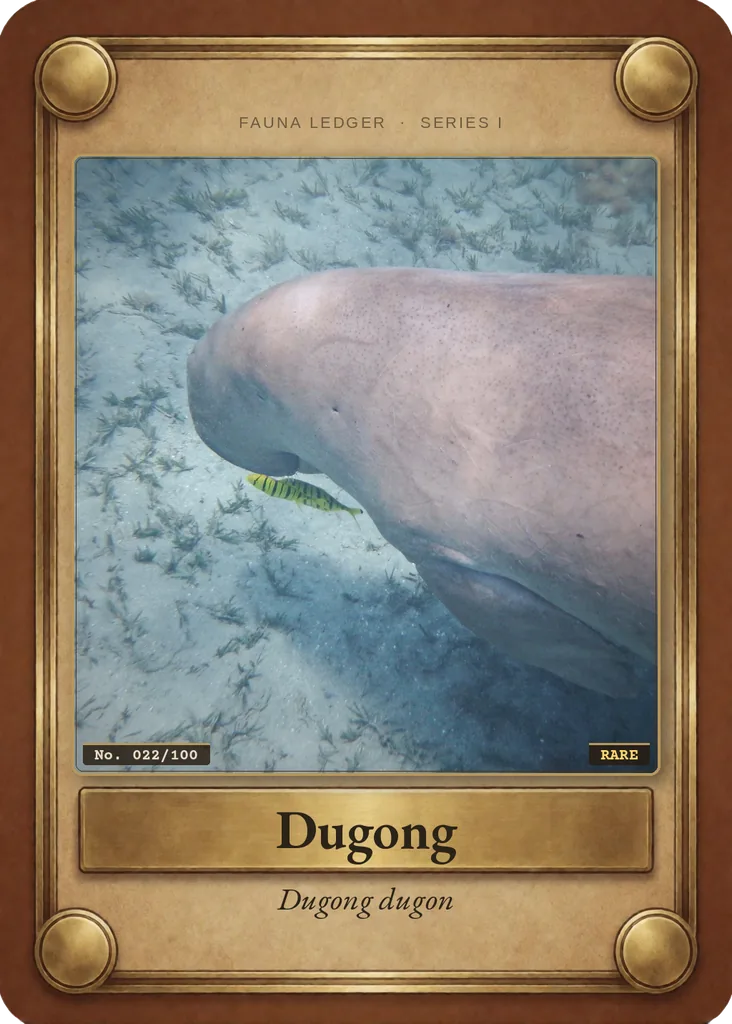
It does not crop the seagrass, it pulls it up. A feeding dugong ploughs the meadow and takes the whole plant, roots included, leaving furrows across the seabed that can be counted from a boat. That is how you survey an animal you almost never see.
Its closest relative was Steller's sea cow, a nine-metre sirenian of the Bering Sea. It was described by Europeans in 1741 and hunted out by about 1768. Twenty-seven years, and the dugong became the last of its family.
You can age one like a tree. Dugong tusks lay down a growth layer a year, so a dead animal can be read off precisely, which is how we know they reach about seventy.
The global listing is Vulnerable and it flatters the picture. Some subpopulations, East Africa and New Caledonia among them, were assessed as Critically Endangered in 2022. Australia now holds the great majority of the animals left.
The mermaid stories are supposed to start here. A large grey animal that surfaces to breathe, holds its calf against its body with a flipper and has a tail like a whale's is at least a plausible origin, seen badly and at distance.
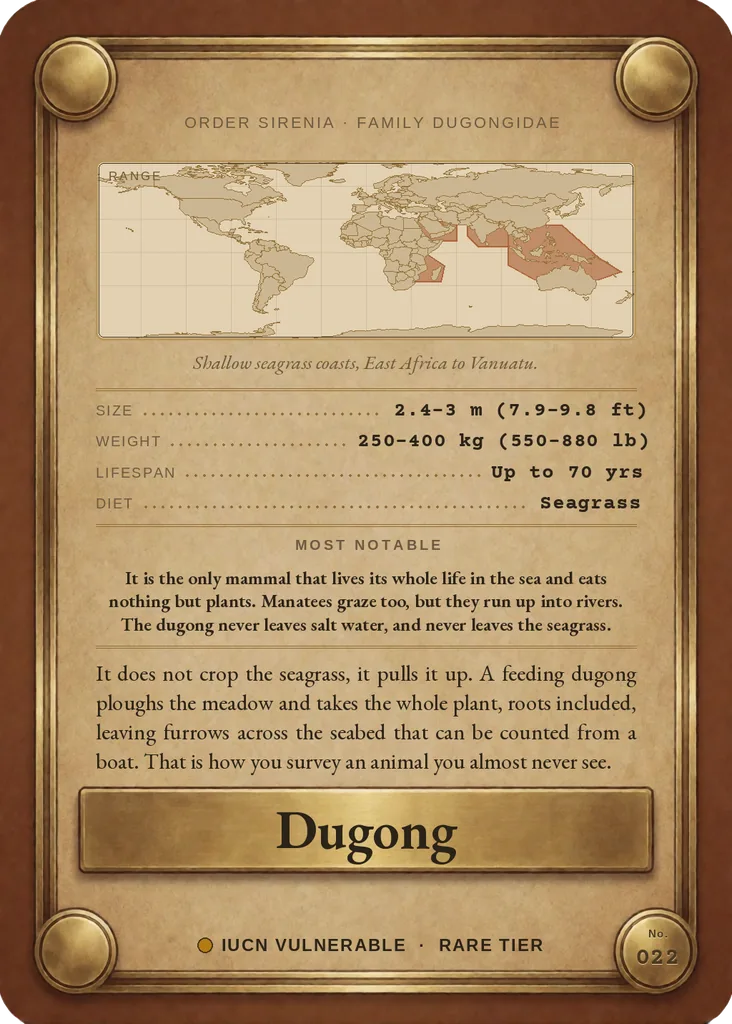
Range: Shallow seagrass coasts, East Africa to Vanuatu.