
Card #014 · Mammals
Asiatic wild ass
Equus hemionus
Uncommon NT · Near Threatened
Field notes
- Classification
- Order Perissodactyla · Family Equidae
- Range
- Deserts and steppe of central and south Asia
- Size
- 2.1–2.5 m (6.9–8.2 ft)
- Weight
- 200–260 kg (440–570 lb)
- Lifespan
- ~14 yrs (wild)
- Diet
- Grasses, herbs, saltbush
Most Notable
Among the fastest equids alive, clocked between 64 and 70 km/h. It needs to be. This is an animal of open desert and steppe, country with no cover in it at all, where speed is the only defence there is.
The name hides a split. As a species the Asiatic wild ass is Near Threatened, about 28,000 animals, but that total is not spread evenly across it. The Persian onager, the subspecies the word onager actually names, is down to a few hundred, and the Syrian wild ass was gone by 1927.
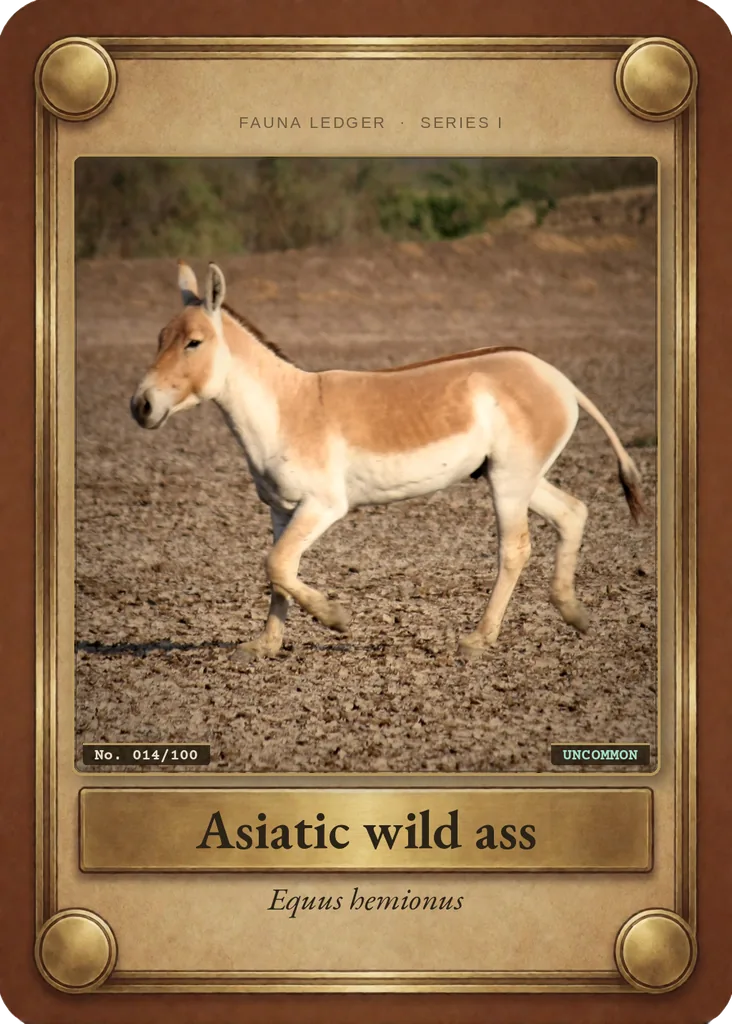
The animal in this photograph is the Indian wild ass, the khur, on the salt flats of the Little Rann of Kutch in Gujarat. It is one of six subspecies, and they range from merely Near Threatened to Critically Endangered to extinct.
It was harnessed before the horse was. Sumerian kungas, the animals that pulled war wagons in Mesopotamia around 2500 BC, were finally identified by DNA in 2022 as crosses between a domestic donkey and a male Syrian wild ass. They are the earliest known animal hybrid bred by people.
Nobody ever tamed the wild ass itself. That is why the kunga existed: the hybrid took the speed of the wild ass and the temper of the donkey, because the wild parent alone could not be handled.
Israel has been putting them back. Asiatic wild asses were released into the Negev from the 1980s, into country where the native Syrian form had been extinct for over half a century.
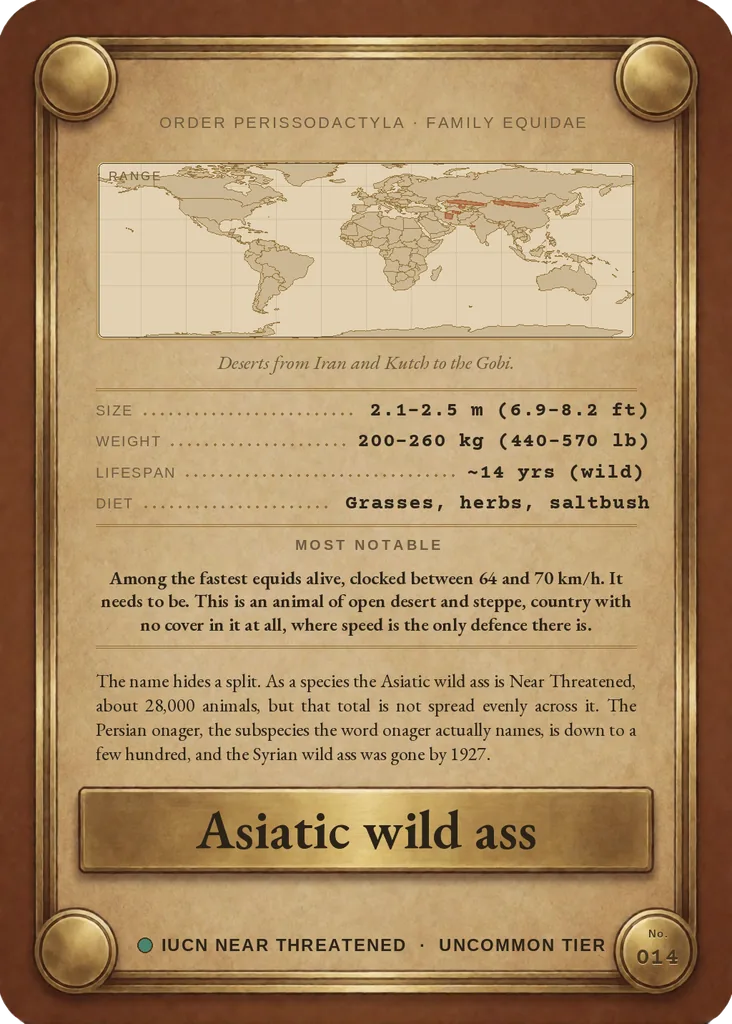
Range: Deserts from Iran and Kutch to the Gobi.