
Card #002 · Mammals
Raccoon
Procyon lotor
Common LC · Least Concern
Field notes
- Classification
- Order Carnivora · Family Procyonidae
- Range
- Southern Canada to Panama
- Size
- 40–70 cm (16–28 in) + tail
- Weight
- Typically 4–9 kg (9–20 lb)
- Lifespan
- 2–3 yrs wild; 20+ captive
- Diet
- Crayfish, fruit, nuts, frogs
Most Notable
Each finger gets its own fold of brain. In its touch cortex, the palm side of every forepaw digit maps onto a separate ridge, walled off from its neighbours by a groove.
Lotor is Latin for 'washer', and it does not wash. Carrying food to water to douse it is a captive habit that has not been seen in the wild. Wild raccoons wade the shallows feeling blind for crayfish and frogs, and the fingers do the looking.
You will read everywhere that water makes a raccoon's paws more sensitive by softening the skin of the pads. It is plausible, but we could not trace it to anyone actually measuring it, so it is not on this card. What has been measured: nerve recordings from the bare skin of its forepaw found the same families of touch receptors that serve a primate's fingertips.
It is a lock-picker with a long memory. In 1908, H. B. Davis gave raccoons 13 different latch and lock mechanisms, and they opened 11 of them in fewer than ten tries. Later studies found they could still solve learned tasks at least three years on.
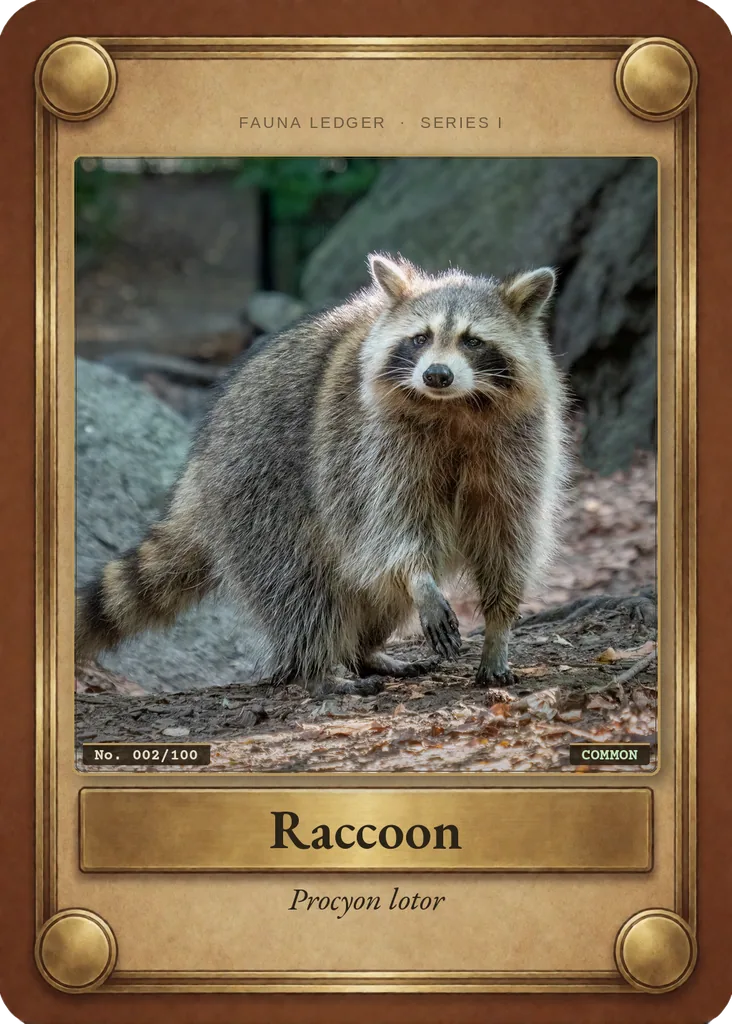
Note the lifted forepaw in the photo. This one was photographed in the Ramble in Central Park, New York, which is native range: raccoons have lived on Manhattan far longer than the city has.
The raccoons of the Bahamas and Guadeloupe were once described as their own rare island species. Genetic and historical work (Helgen and Wilson, 2003) showed they are Procyon lotor, brought over from the eastern United States by people.
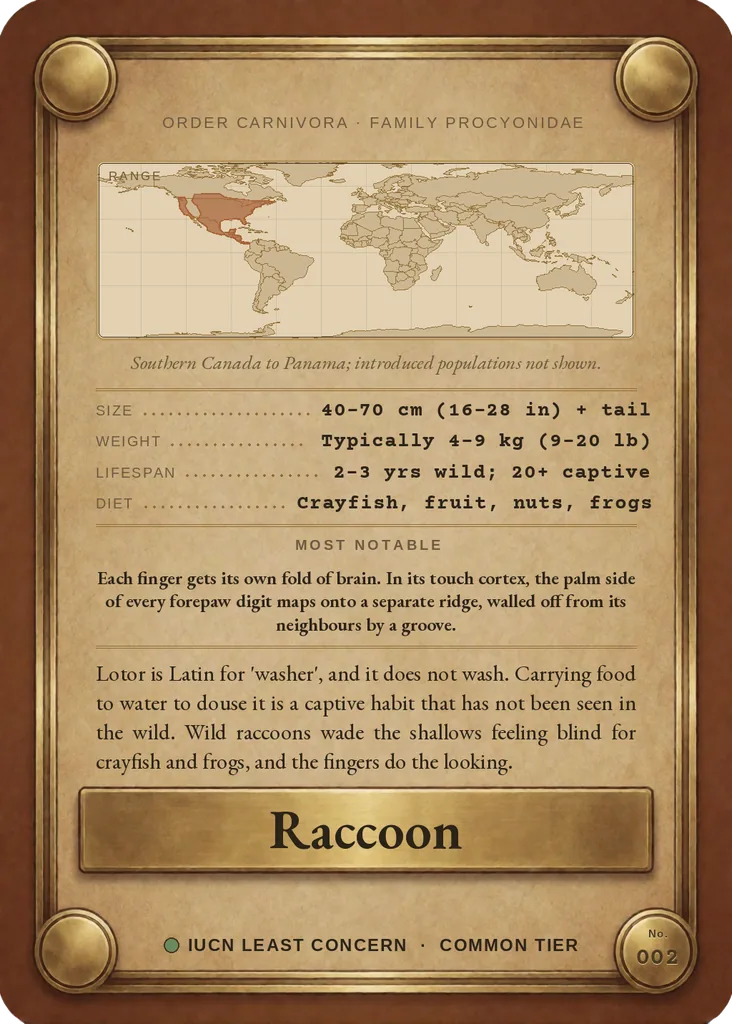
This map is the native range only. Raccoons are also established in central Europe, the Caucasus, Japan and several Caribbean islands, from 20th century escapes and deliberate releases, and are not drawn here. The EU has listed the raccoon as an invasive species since 2016.
Range: Southern Canada to Panama; introduced populations not shown.