
Card #001 · Mammals
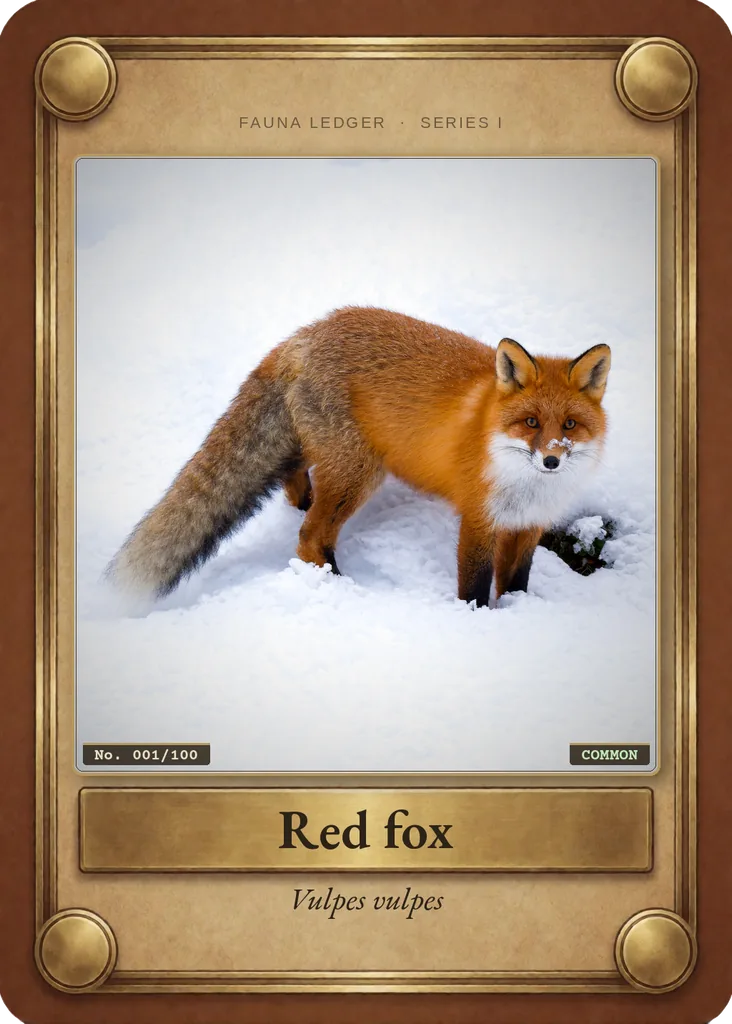
Red fox
Vulpes vulpes
Common LC · Least Concern
Field notes
- Classification
- Order Carnivora · Family Canidae
- Range
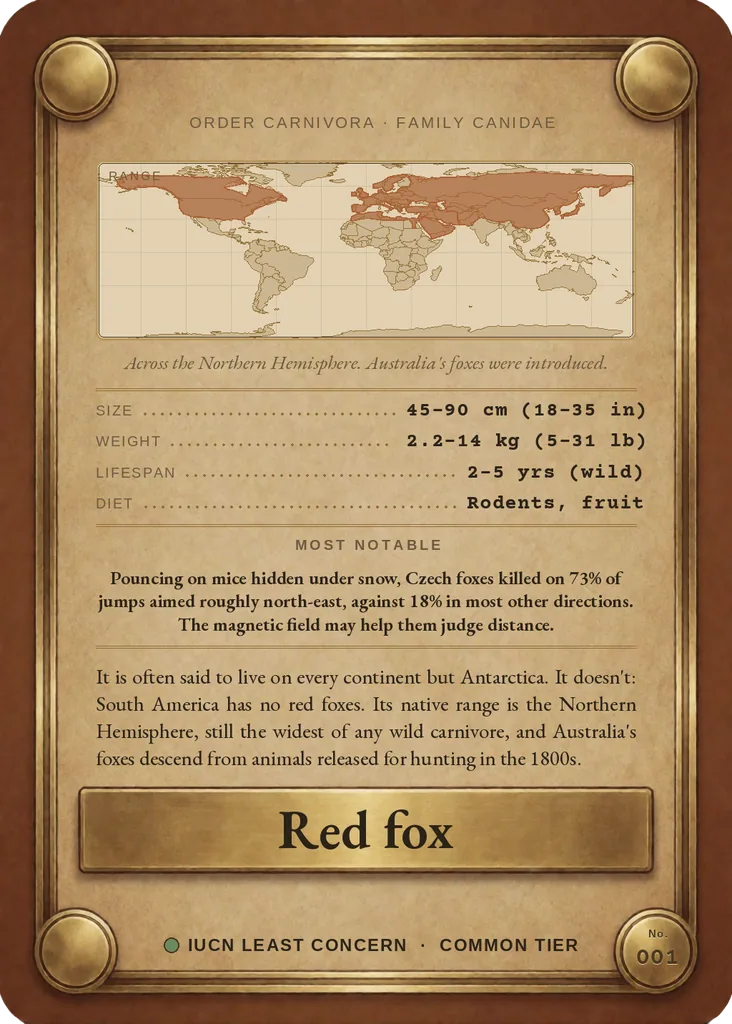
- Northern Hemisphere; introduced to Australia
- Size
- 45–90 cm (18–35 in)
- Weight
- 2.2–14 kg (5–31 lb)
- Lifespan
- 2–5 yrs (wild)
- Diet
- Rodents, fruit
Most Notable
Pouncing on mice hidden under snow, Czech foxes killed on 73% of jumps aimed roughly north-east, against 18% in most other directions. The magnetic field may help them judge distance.
It is often said to live on every continent but Antarctica. It doesn't: South America has no red foxes. Its native range is the Northern Hemisphere, still the widest of any wild carnivore, and Australia's foxes descend from animals released for hunting in the 1800s.
The magnetic idea is still a hypothesis. The 2011 study (Červený and colleagues, Biology Letters) logged nearly 600 pounces by 84 foxes over two years, and the pattern held, but no one has yet found the sense that would explain it.
A fox can hear a rodent moving under the snow and pinpoint it before it jumps. The high, arcing pounce is how it punches down through the crust onto prey it cannot see.
North American red foxes may turn out to be a separate species. Genetic studies have revived the old name Vulpes fulva, but the IUCN still treats all red foxes as one species.
This map shows the native range only. In Australia the red fox is an introduced predator and one of the main threats to small native mammals, so it is not drawn here.
Range: Across the Northern Hemisphere. Australia's foxes were introduced.